

It’s now 11:56 PM and three Claude Code and four Codex terminals are still open. Blinking. The last commit pushed was authored by claude-opus-4-7 and co-authored, politely, by me.
The build is finally done spinning and CI is, thankfully, green. Something feels off. Not the code. Nah, its fine. I can’t point at it. A small absence where a feeling used to be.
I think it’s presence.
The most in your face argument in 2026 is about craft
Steve Yegge, in conversation with Tim O’Reilly a month ago put it as bluntly as anyone has: “Code is a liquid. You spray it through hoses.”
Wes McKinney (the guy who wrote pandas) burns over ten billion tokens a month writing vast amounts of Go he has never manually typed1. In February, a Hacker News thread titled “The future of software development is software developers” pulled in hundreds of comments, many from senior engineers arguing that the limitations outweigh the benefits and produce, predictably, hard-to-debug interwoven abstractions.
Every week the orange site hosts another version of the same fight: does the thing we used to do with our hands still matter now that a machine can do it without hands?
That’s the argument in the foreground.
The argument underneath is different.
It’s the feeling of subtraction. Marco Kotrotsos put it well on Medium: AI didn’t fix developer burnout. It reshaped it. Companies take the minutes AI saves and refill them with more work. The people hit hardest are often the ones who lean in hardest.2
The coverage mostly blames the tools and I’m not convinced that’s right.
Here is what I think is going on
Every line of software anyone has ever shipped has actually been a group conversation.
When Stack Overflow provided the answer that unblocked you at 2 AM, it was written by someone whose name you forgot before you successfully pasted the snippet.
The library you imported was argued into existence on a mailing list you never read. The pattern you used was formalized in 1994 by the Gang of Four, who were themselves remixing Christopher Alexander’s 1977 book on architecture3.
The ticket that defined the feature was the residue of a customer complaint, forwarded by a sales rep, shaped by a PM, softened in Slack, and eventually compressed into a sentence small enough for Jira.
Some commit histories look like sole authorship.
But 99.9% of work is not sole-authored.
We have a useful fiction we call the solo maker
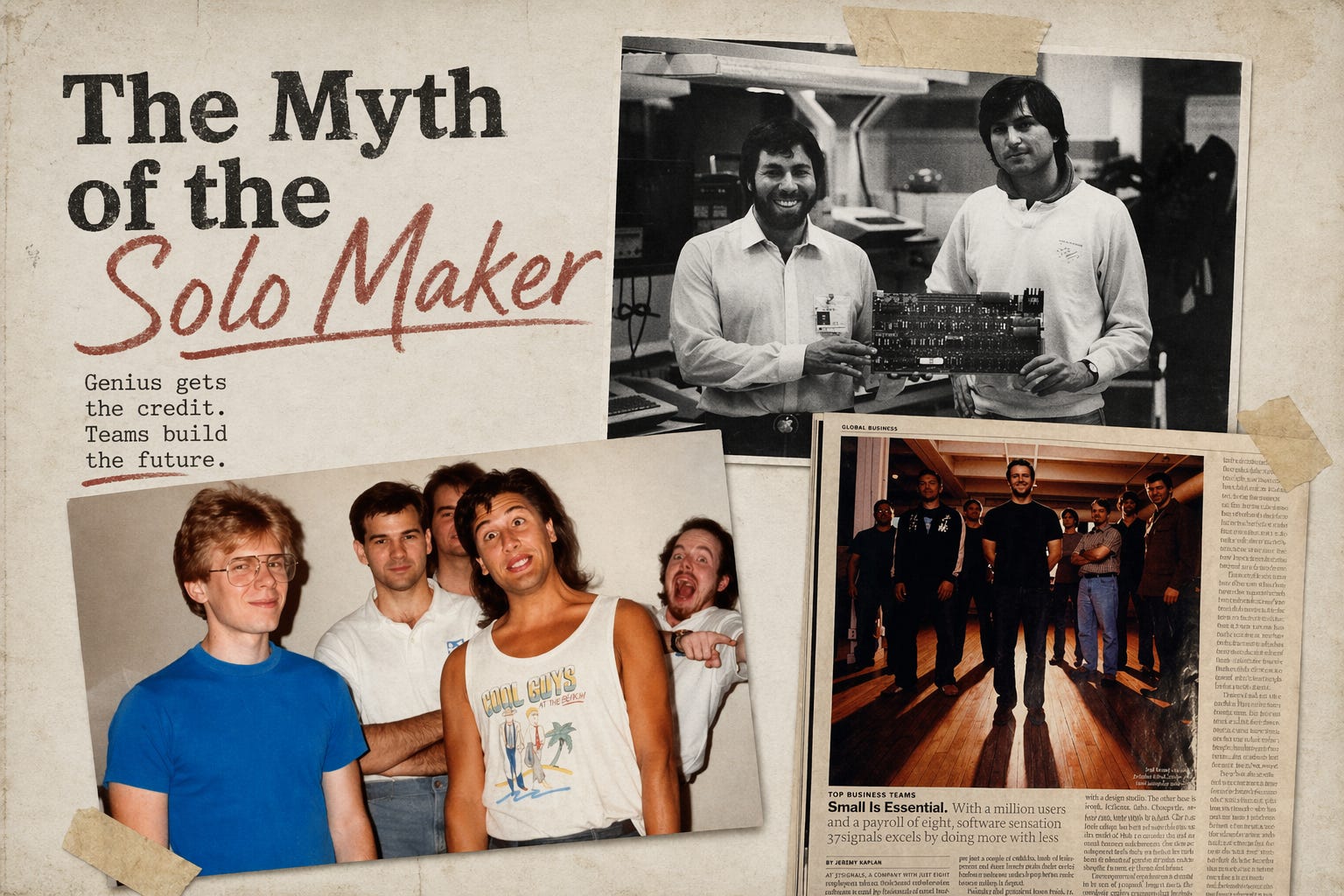
Woz soldering in the Los Altos garage. Carmack in the Texas pool house writing Quake. DHH extracting Rails from Basecamp on his laptop.
The lone genius hoodie poster above the desk. This fiction makes promotions legible. It made technical career ladders work. It flattered us and we let it.
All of those founders had co-founders. Woz, Jobs and the Homebrew Computer Club. Carmack, Romero and the whole id team. DHH, 37signals and every Ruby contributor upstream.
The myth stripped out the company around each one, because the myth needed a single name to hang the story on. We told it anyway and hung the posters.
Its sequel is currently being written. Altman has been floating the one-person billion-dollar company since 2024. His CEO friends, he told Alexis Ohanian in a conference interview, had a betting pool on when the first one would arrive4.
This line got reported, reshared and of course, believed. In late 2025 Altman said publicly he was “dangerously close” to calling the bet won. The solo unicorn is now someone who looks a lot like Pete Steinberger.
Except the solo founder is never truly solo.
Now, they’re standing on a training corpus written by millions of people, models built by thousands, infrastructure rented from five trillion-dollar firms, and the open-source stack underneath all of it. Their payroll might be one. The graph of people whose work is in the product has never been larger.
The myth rewrote itself for the new era with disregard for the math.
What is actually happening now, in these late hours, is translating. From a customer call in Q3. From a constraint a CTO set eighteen months ago. From a convention a principal engineer taught someone on their first job, who’d learned it from Fowler.
This translating might feel solo but the source is always other people.
There’s a reason the word stoa exists
Zeno of Citium taught philosophy around 300 BCE. He didn’t rent a private study. He taught on a public painted porch in the middle of Athens, where other people could overhear and push back. The school took its name from that porch.
Stoicism, before it was anything else, was a claim: thinking is something humans do together, out loud.
Software has always had versions of the same idea. Kent Beck and the XP movement spent decades arguing that pair programming was the natural form of the work. The industry nodded politely, then kept shipping solo-committer org charts, despite the social act that was already happening in Slack, standups, review comments, and hallway conversations.
Craft has moved.
Anyone shipping with agents knows this already. Put agents on a good codebase and they tend to replicate good practices. Put them on a bad one and they compound the bad. Craft has moved upstream, into taste, judgement, context, and the ability to tell the difference.
What got lost is the ritual that made us feel the craft.
The satisfaction of holding a hard refactor in your head for three hours before writing a line. The muscle memory of a language you grew up in. The private rhythm of fingers on keys. Those are real losses.
But some things weren’t ours to begin with. The authorship story. The idea that our commit was the first moment of creation. The idea that somewhere upstream of the keyboard was a spark of private genius that we alone lit. Those were always on loan from a culture that flattered us.
So what is still ours after the typing leaves?
What’s worth building.
What correct means in this context. Which tradeoff to accept. Who the customer is and what they would say. Whether the spec captures what the team actually decided or a softened version of it. Whether to ship or wait. Whether, given everything, this is the right move at all.
That was always the actual job.
Typing was just the evidence of the job.
Marcus Aurelius saw this two thousand years before he could have imagined a coding agent:
We were born to work together like feet, hands, and eyes, like the two rows of teeth, upper and lower. To obstruct each other is unnatural. — II.1
He wasn’t telling us to network. He was saying the private self is a late invention. The first fact about us is that we come in pairs, rows, pods.
We were never alone at the keyboard. We were always one part among others.
The developer at 11:56 PM, looking at the diff and feeling like a ghost, isn’t having a craft crisis.
They’re having the first honest conversation with their own work the job ever allowed. The ritual that hid the conversation just got cheap enough to stop.
Stoa was the name of the school because thinking needed company5. Make was never a solo verb. And AI didn’t end the age of the solo maker.
It ends the age of pretending we are alone.
Marco Kotrotsos, AI Was Supposed to Fix Developer Burnout, Medium, February 11, 2026. The broader pattern is also documented in Bedard, Kropp, Hsu, Karaman, Hawes, and Kellerman, When Using AI Leads to “Brain Fry,” Harvard Business Review, March 5, 2026; Appknox, AI & Developer Burnout Report, 2025; and Gergely Orosz, The Impact of AI on Software Engineers in 2026, Pragmatic Engineer, April 2026.
Gamma, Helm, Johnson, and Vlissides, Design Patterns: Elements of Reusable Object-Oriented Software, 1994, drawing explicit influence from Christopher Alexander, A Pattern Language, 1977.
Could AI create a one-person unicorn? Sam Altman thinks so — and Silicon Valley sees the technology ‘waiting for us,’ Fortune, February 4, 2024, quoting Altman’s September 2023 conference conversation with Alexis Ohanian.
I’ve wrote last week about why single-player building has always been fiction: see Where Makers Meet. This meditation is of course, what is underneath.