

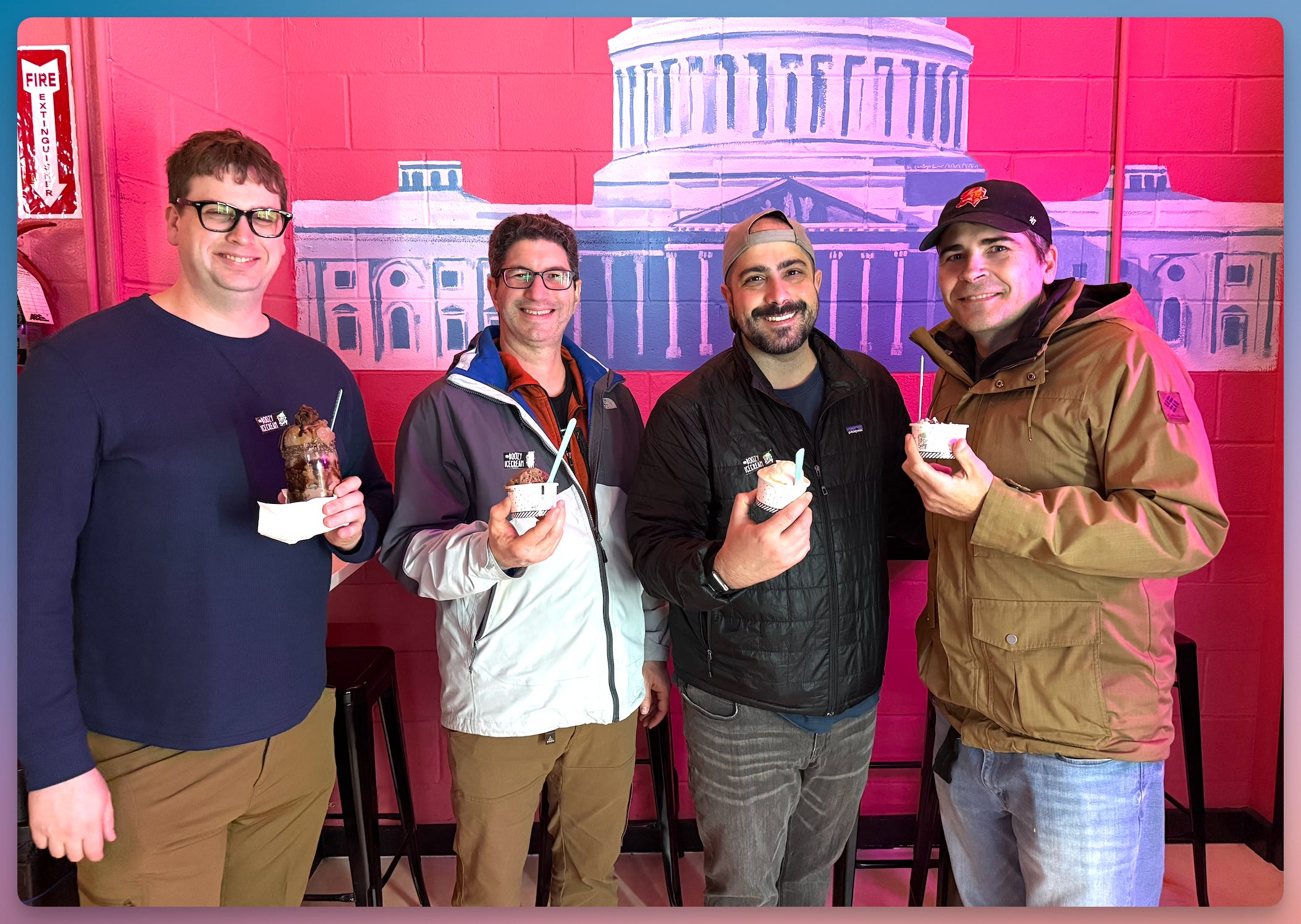
🔌 Excited, terrified, and weirdly relieved to share the thing we've been living inside for seven months. No not an ice cream parlor. A room where makers meet… humans, agents, and all. withstoa.com. The door is open. Come in.
If you’ve ever read Thiel’s 0 to 1 you know its core thesis. Real progress comes from creating something new rather than copying what works. Agents are having their moment and a once blue ocean is a now a much darker shade of red.
In Tech having an agent or a chatbot or an agent and a chatbot is de rigueur.
Its why every product you once knew is slowly morphing into yet another homogenous input box beckoning you to “ask anything”.
But surprisingly, for many, it turns out that knowing what to ask is an incredibly intimidating problem.
I wouldn’t have initially thought so given my boundless questioning. Like many I spend the lion’s share of my day doing just that. Typing, speaking, ranting and smashing my keyboard into small, lifeless but surprisingly “lifelike when they respond” input boxes.
And doing that for long enough has given me a lot of time to ponder. Is this the future of software? Yelling at command line interfaces in English and having “software” pop out the other end? Well of course, on one hand, yes. Writing hand crafted artisanal code is fast becoming a cottage industry.
But building software solo will never truly be a thing1. And yet everywhere you look these days there is a new “AI product” that promises just that.
You and the AI copilot get to cowork alone but “together” and make that thing that you’ll end up sharing: from zero to one. And look, there’s nothing particularly wrong with that.
But there is something missing.
I think one of the primary reasons Multiplayer AI is not yet everywhere is that people don’t quite understand what it should look like.
Where do you put it? In a group chat thread?
How does it work?
What’s the shape of the thing?
There is nothing yet to copy because it just doesn’t really exist.
And since most “computing experiences” are by definition personal there isn’t yet a shared substrate to build on. Your cursor is yours. Your chat is yours. Your context, yours. And it dies with the tab.
But building, really truly building, is never just personal.
Before computers, makers had workshops. Writers had smoke-filled rooms with typewriters you could hear across the hall. Musicians have studios. Every discipline that ever made anything has had a place where that making happened. A place everyone could see and reach at once.
The Greeks had a word for this.
A stoa. A covered walkway where people gathered to think together. Zeno taught philosophy in one. The whole school was named after the building. Not a curriculum. Not a founder. A place.
Because for two and a half thousand years we understood something we seem to have forgotten: the room precedes the idea. You don’t get to truly refined thought without a place to hold it. You don’t get to a decision without a surface to sketch it on. And you sure as hell don’t get to a thing a ton of people want without a space where many hands can touch it at once.
Nobody really meets anywhere anymore.
We just relay.
So what is the shape of multiplayer AI?
It is not just a group chat with a bot in it. That is relay, dressed up.
It is not just shared document with an agent scribbling in the margin.
Its not just Zoom with extra note taking apparatus that replace Granola. No, that’s just copying.
The shape is a room. A space with walls and a floor and your people and your agents all invited. A place where the conversation is the artifact. Where a decision made at minute six is captured before minute seven. Where the agent you summoned can see what everyone else sees and hear what was just said. Where the thing you’re building is right there “on the wall” alongside the reason you’re building it.
Not a chat. A workshop.
Not a copilot. A colleague.
Not a transcript. A record.
When you leave that room, it should remember. When you come back tomorrow, it is still there. When a new person shows up, they can read the walls. The context compounds, because the context was shared in the first place.
This is the thing that does not exist yet in the rest of your stack. This is the thing that is missing from every “AI product” that promises you and your copilot can ship from zero to one alone.
You can’t and you won’t because you never really could.
The next decade of software will not be won by the best solo builder with the best pet agent. It will be won by the teams who figured out how to build together, with agents, in one room.
A stoa was a porch. Open on one side to the market, closed on the other against the weather. You could step in off the street and join the argument already in progress. Someone would catch you up. Someone else would disagree. By the end of the afternoon you had a new idea and so did they, and none of you could quite remember whose it was first.
That was the point.
That is still the point.
And its why we think makers meet withstoa.com
Personal Coda
It’s been seven long but genuinely joyful months since my cofounders Jake, Sean and I decided to embark on this particular rung of our journey and build a team product. Looking back now, I’m not quite sure what we were thinking but we’ve sure learned a whole hell of a lot.
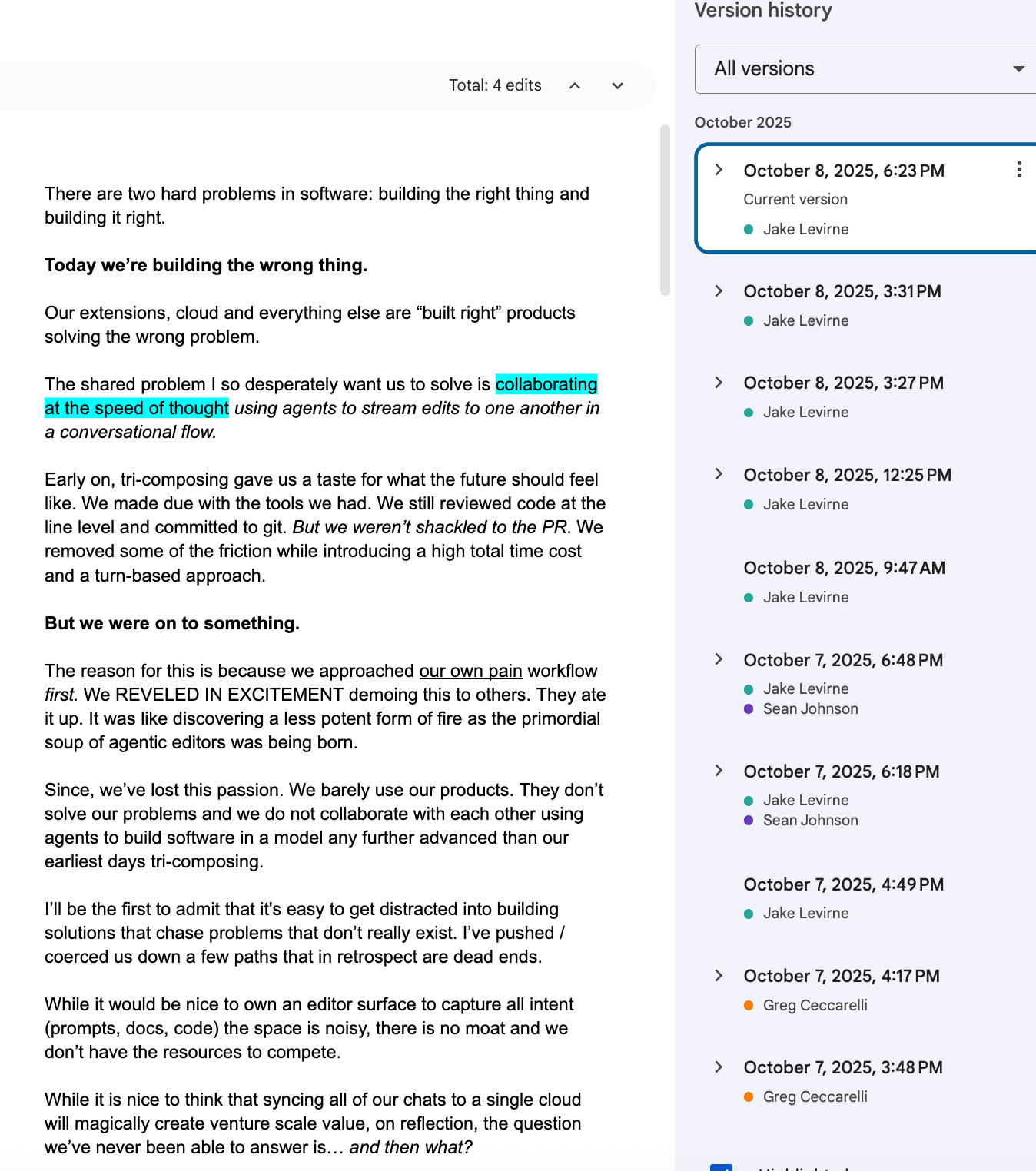
In October of last year we were riding high on the initial success of our extensions. A lot of people use them, love them and still do. But we came to terms with the fact that we were building the wrong thing2.
The problem that drives me, drives us, is one of shared mental alignment. Its the hardest problem to solve and has been even pre AI. But now the stakes are so much higher. It used to be hard to scrape together the talent to go zero to one. Now, it is decidedly not.
And so what do we do? Well what we did was scratch of own itch. We’re remote so when we met it was on Zoom or Tuple. And so, we rebuilt that. And when we planned it was in Gdocs. But agents don’t Gdoc. So we rebuilt that. And when we code we version our code. But pushing and pulling at rapid pace doesn’t quite work at the rate we move now, so we rebuilt that. And of course when we prompt, we do so solo. We can’t see what anyone is writing or thinking until after the fact. So we rebuilt that too.
The honest answer is that what Stoa is today fused and formed through molding and heavy interrogation. Organically. Since late last year we’ve lived in between it’s digital walls every day and have bent it to our will.
'And we will continue to bend it: to the will of many many more people that we know share the same same pains and desires we do.
We want our documents to be local first but inherently collaborative.
We want to share to share our thinking process by default.
We don’t want to fight against our tools that span video, voice, writing and agentic sessions. We want them to capture our intent.
We don’t hate meeting but when do we want to make sure our meetings work for us.
And we want the place where we spend our days to be durable not ephemeral.
And all of that really adds up to one thing. We wanted a place where makers could meet.
So we built one and will continuing building it.
The door’s open. Come in.
For every indie hacker out there that has made something incredible solo, what you have to remember is that its never made in a vacuum. Software isn’t software until it makes contact with reality: it’s used, abused, improved or discarded. Every user insight, complaint, review, critique and accolade shapes what it is… even if there is just a single
An internal gdoc excerpted from that time
Brilliant!
Stoa is a perfect name for your product!
Kudos!