


A company used to be a place where intelligence was scarce. You hired it. You gathered it. You arranged it into rooms and calendars and “teams,” and then you built elaborate social machinery to make it add up to something coherent. Titles, roadmaps, meetings, handoffs, approvals…. these were not cultural quirks. They were the coordination technologies required to turn scarce cognition into reliable action.
Cheap intelligence breaks that bargain.
Not because it makes people stupid. Because it makes action abundant. When anyone can generate a plan, a spec, a design, a pricing model, a prototype, a pile of code, a launch email, a competitive teardown, a forecast, a hiring rubric and when every employee and every agent can spin up competent output on demand, the constraint stops being “can we think of something?”
The constraint becomes: what will we commit to together?
Artifacts are now infinite. Commitments are not.
That's the part we don't have a good mental model for yet. We keep trying to bolt new capabilities onto old organizations, and then act surprised when the org starts to feel slower, not faster. Of course it does. You just multiplied the number of plausible moves by a hundred. You didn't multiply legitimacy, trust, or shared context.
Part 1: Fifty Years of Coordination Problems
To understand what cheap intelligence disrupts, you have to understand what it was built on top of. The modern firm is a layered artifact of coordination technologies, each invented to solve the previous era’s bottleneck. The story of corporate collaboration over the past half-century is less a tale of progress than an ongoing negotiation between the scarcity of human attention and the ambition of collective action.
In 1937, Ronald Coase posed the question that would earn him a Nobel Prize: if markets are so efficient, why do firms exist at all? His answer was elegant:
Firms exist because transaction costs (the friction of finding, negotiating, and enforcing contracts on the open market) are often higher than the cost of managing those activities inside a hierarchy.
Oliver Williamson later expanded on this, adding the concepts of bounded rationality (our limited cognitive abilities) and opportunism (people acting in self-interest) to explain why firms organize the way they do.
This was the fundamental bargain: the firm as a structure that absorbs the costs of coordination so that individual humans don’t have to negotiate every interaction from scratch. Hierarchies were not just power structures but rather compression algorithms that reduce the combinatorial explosion of “everyone talks to everyone about everything” into something metabolizable.
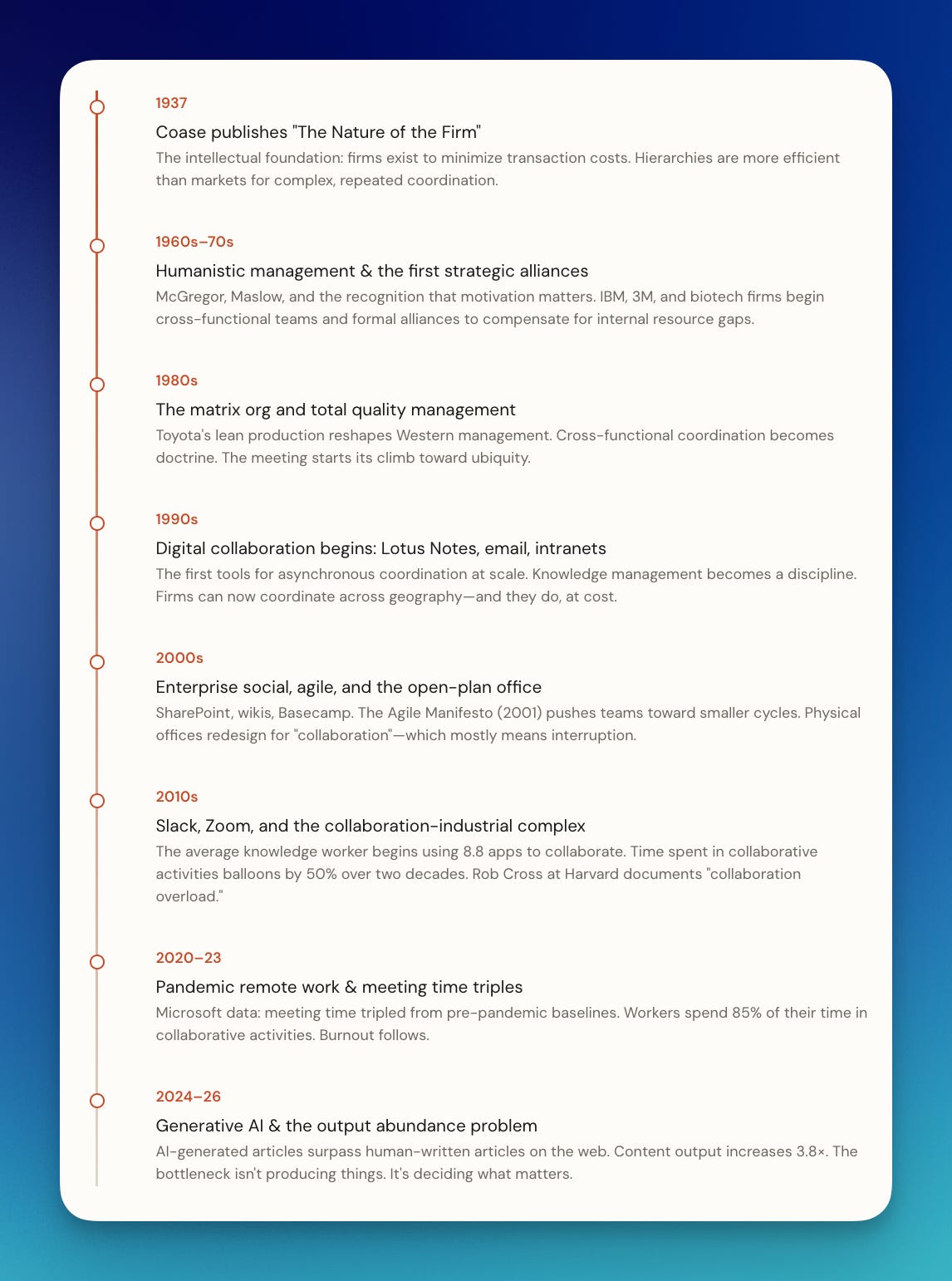
Notice the pattern? Each era introduces a new coordination technology (hierarchy, process, digital tools, real-time messaging) that solves the previous constraint only to reveal a deeper one. The tools keep getting better at moving information. But none of them have gotten better at manufacturing agreement.
This brings us to the present, and to the most disruptive reframe of Coase’s original insight. As a recent California Management Review piece puts it1, AI doesn’t eliminate transaction costs but rather transforms them. The activities that comprise transaction costs (learning prices, negotiating terms, writing contracts, monitoring compliance) are precisely the tasks that AI can perform at near-zero marginal cost.
But when AI collapses the cost of production and analysis, what remains is the cost of trust, verification, and coordination.
Old friction disappears and new friction emerges.
Part 2: The Old Firm: A Scarcity Engine
In the pre-cheap-intelligence world, collaboration mostly meant “help me do the thing I can’t do alone.” Expertise was unevenly distributed. Learning was expensive. Writing and analysis were time-consuming. Building required specialized hands.
So coordination systems evolved to route scarce cognition to the right problems and prevent expensive mistakes. The hierarchy compressed decisions. The meeting concentrated attention. The memo formalized thinking. The approval gate caught errors before they propagated.
If intelligence is scarce, then the goal of collaboration is to share it.
The entire social architecture of the twentieth-century firm from org charts to quarterly reviews to the very concept of “alignment” was designed for this purpose.
It worked because the constraint was clear: we don’t have enough smart people, or enough hours, to think about everything.
So we specialize, and then we coordinate the specialists.
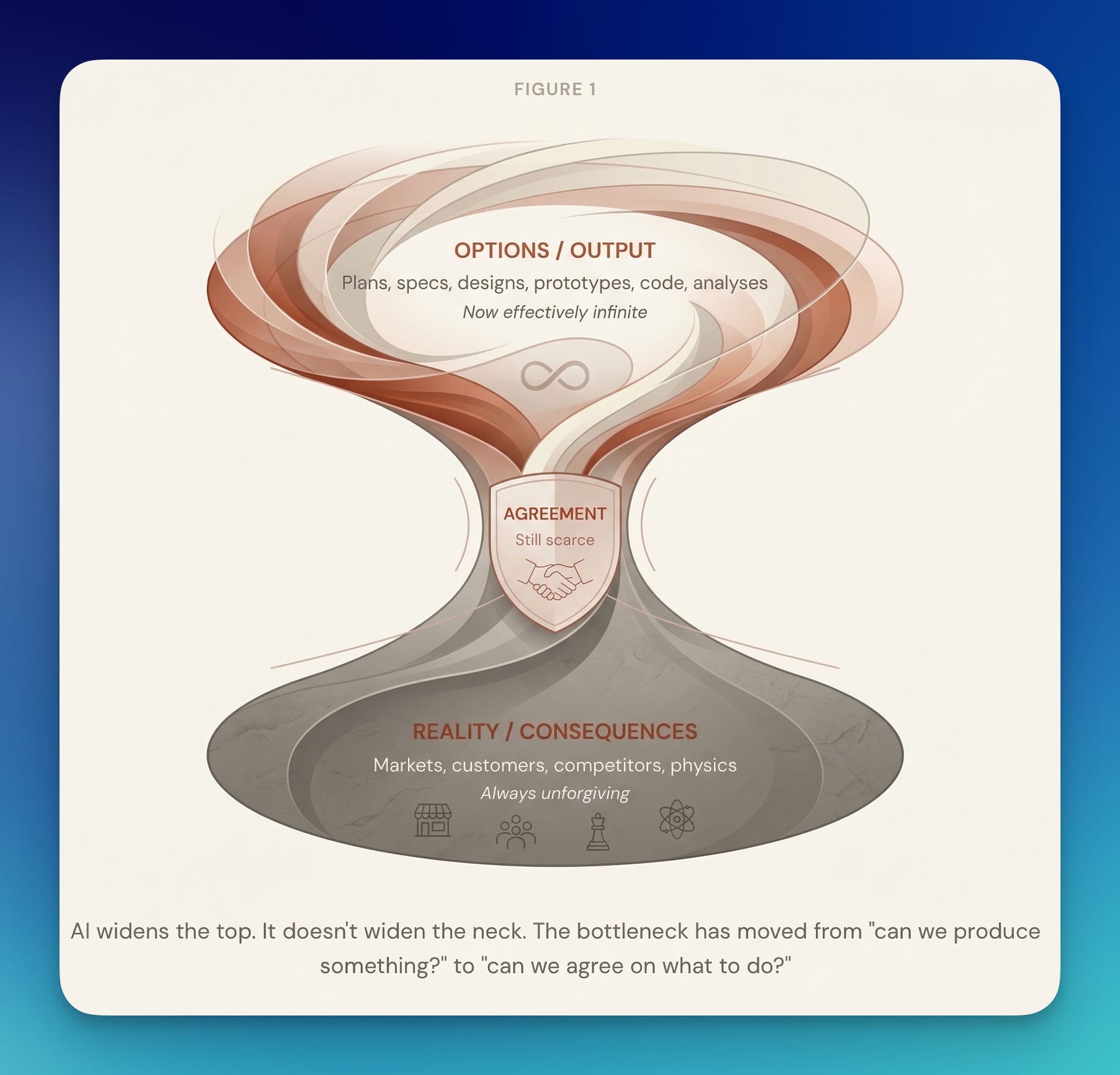
Cheap intelligence flips the gradient. Now the default state is not “we can’t think of a good answer.” It’s “we have ten good answers by lunch.” You won’t suffer from a lack of options.
You suffer from an excess of plausible futures.
This is why modern collaboration starts to feel like endless alignment, lightweight civil war, decision déjà vu, shipping things you can’t quite explain, and “everyone agrees” right up until it matters.
The organization hasn’t become irrational. It has become overstimulated.
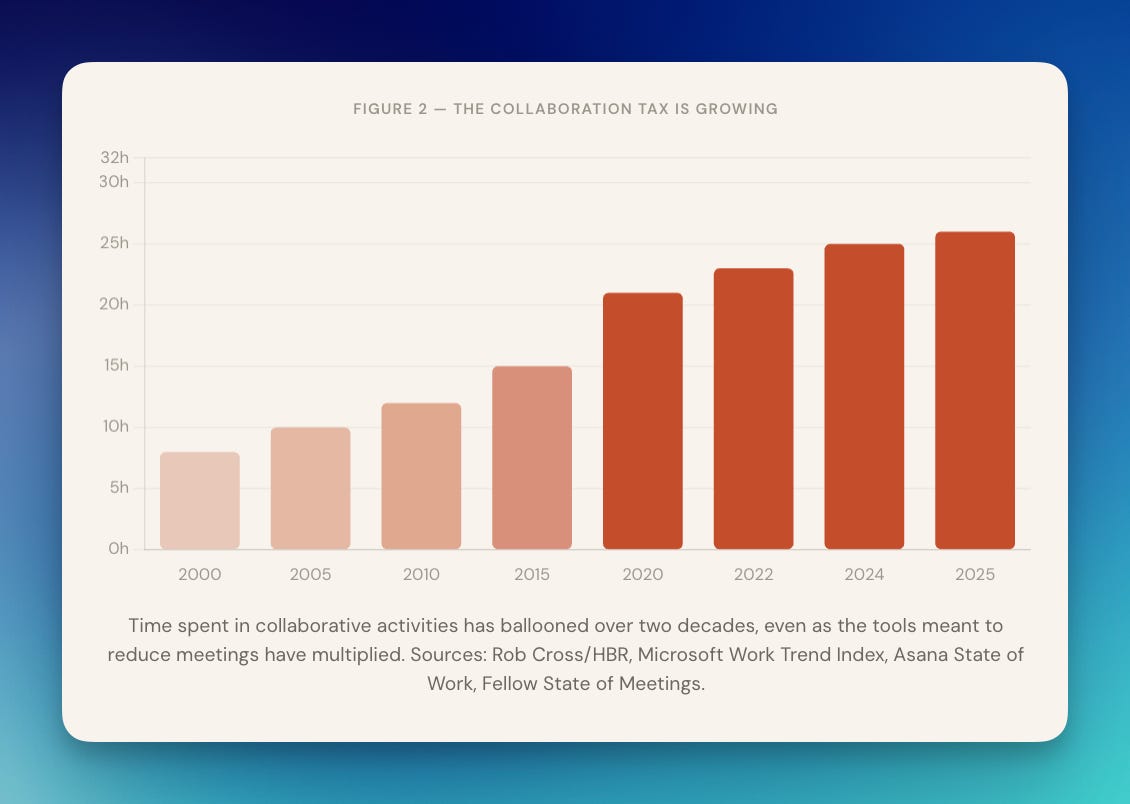
When action is cheap, the cost of a wrong move doesn’t go down. Often it goes up, because the wrong move can now be made at scale and at speed. So the firm responds the way firms always respond to risk: it grows antibodies. Meetings. Reviews. Approvals. Committees. “Stakeholder” proliferation. Process disguised as prudence.
And then we say: “AI didn’t work. It slowed us down.”
No. AI revealed what the company actually is.
Part 3: The Thing Called “Collaboration” Was a Side Effect
We’ve long treated collaboration like a moral virtue: be a team player, communicate, align, be cross-functional.
But historically, collaboration was an emergent behavior produced by constraints. When work was hard and expensive, people had to coordinate carefully because mistakes were costly and iteration was slow.
Rob Cross, the leading academic researcher on organizational collaboration, has documented this paradox across 300 organizations: the time spent by managers and employees in collaborative activities has ballooned by fifty percent or more over two decades, yet in most cases, twenty to thirty-five percent of value-added collaborations come from only three to five percent of employees. The rest is overhead leading to meetings that don’t decide, messages that don’t clarify, “alignment” sessions that align nothing.
Huxham and Vangen2 formalized this dynamic in their theory of “collaborative advantage” and its shadow, “collaborative inertia” or the tendency for group work to produce slow, negligible progress rather than synergy. Their insight was spot on:
The difficulty isn’t getting people to collaborate.
It’s getting collaboration to produce outcomes rather than process.
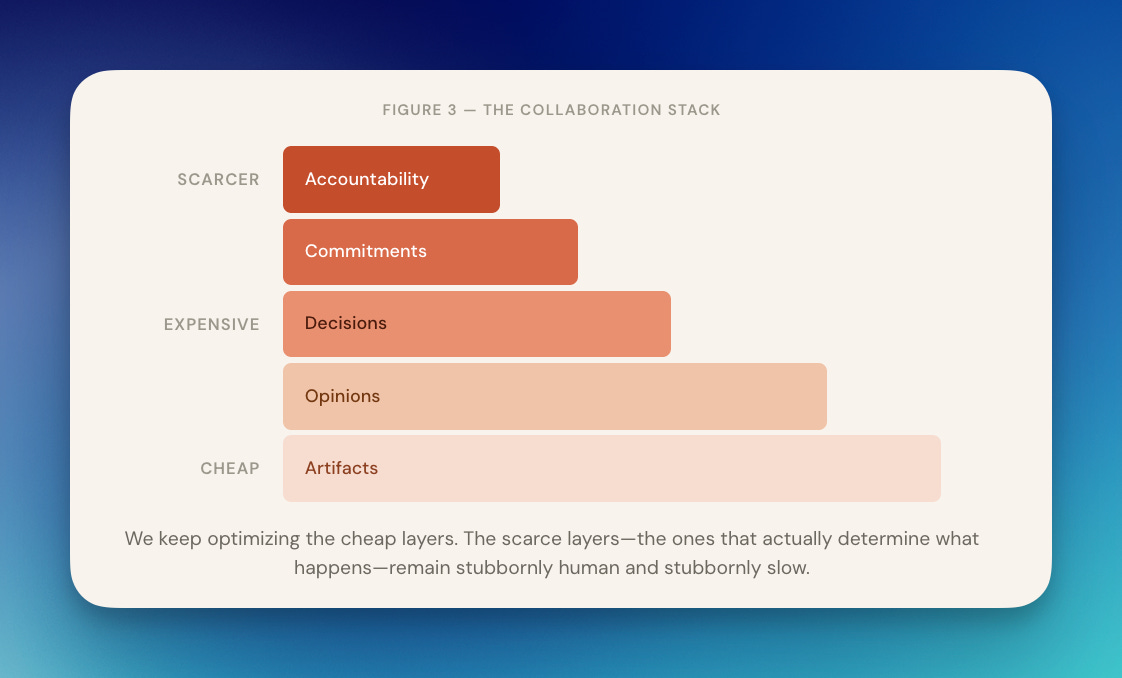
When work becomes easy, collaboration stops being a nice-to-have. It becomes the core product. Because the real output of a firm is not artifacts. It’s commitments that lead to outcomes.
The (Actual) New Bottleneck is Legitimacy
In a world where any memo can be written, any prototype can be generated, any analysis can be conjured, the persuasive power of artifacts collapses. If everyone can produce a beautiful deck, then decks don’t convince. If everyone can generate competent code, then code doesn’t explain. If everyone can produce “research,” research doesn’t settle.
So organizations will drift toward politics. Not because people get worse, but because legitimacy becomes the scarce input. Legitimacy is what lets a group say:
This is the plan,
This is the priority,
This is what we mean, and
This is what we’re willing to be accountable for.
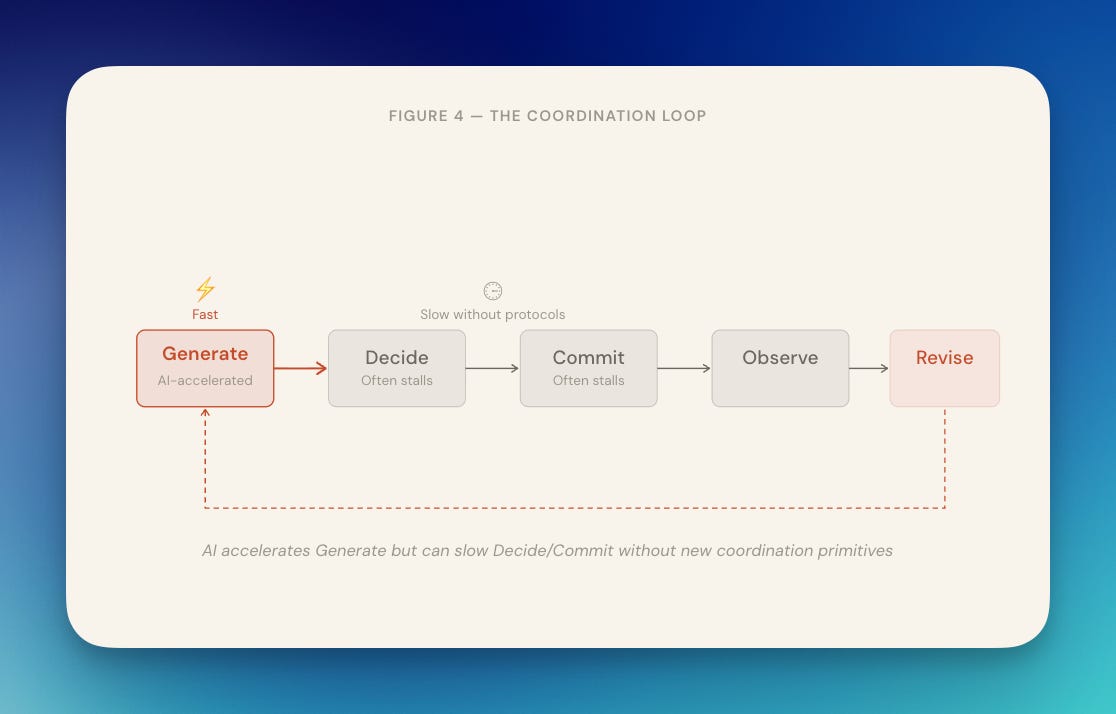
Cheap intelligence creates a perverse dynamic. Output increases. Context can easily fragmens. Trust gets stressed by the increased surface area of action. The system compensates with more process. Everyone feels slower and less agentic.
That’s the loop. You can’t “tool” your way out of it. You need a new paradigm for what coordination is.
Part 4: From Pyramids to Meshes
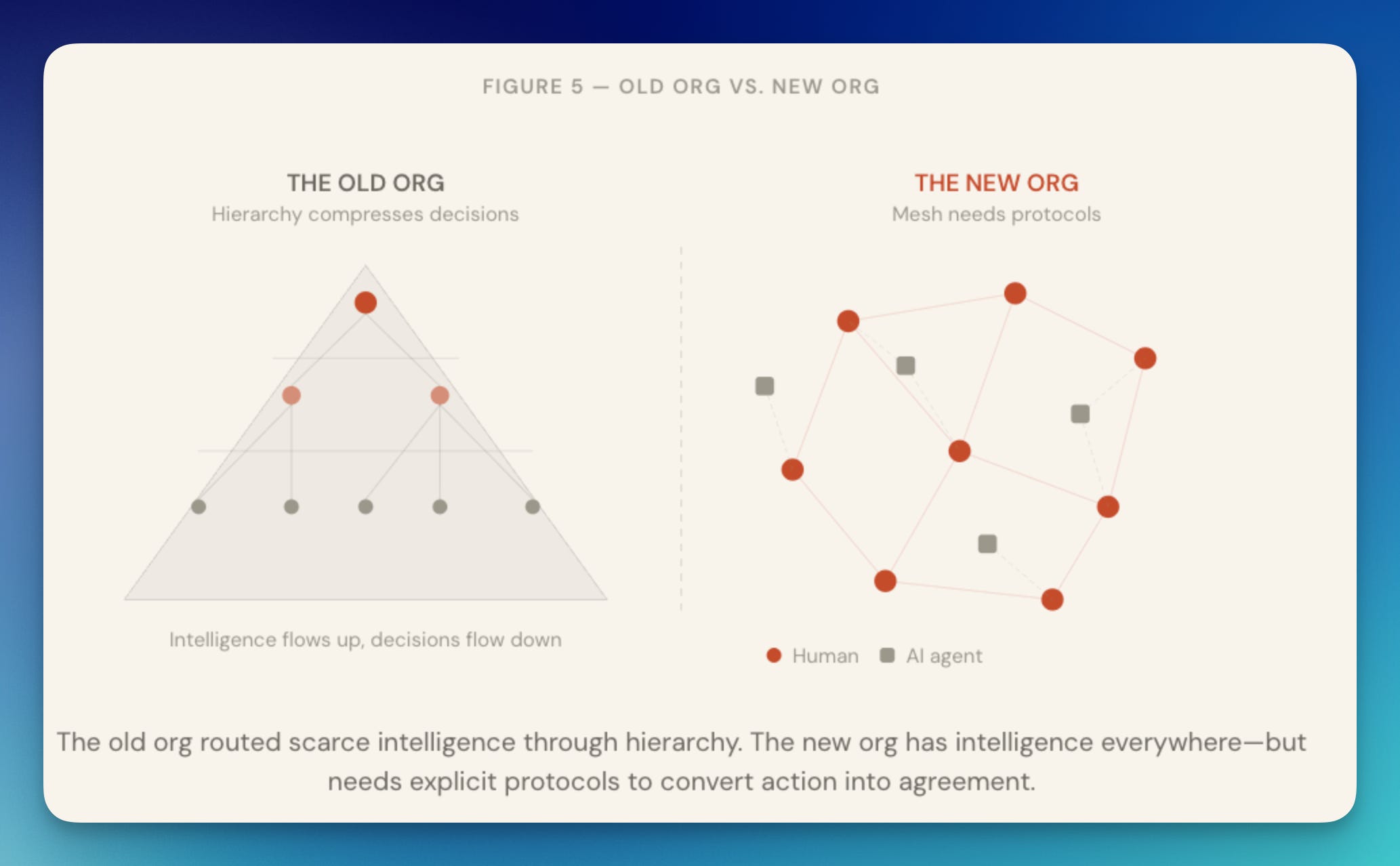
The old organization was a pyramid. Information flowed up; decisions flowed down. The hierarchy compressed the decision space—not because bosses were smarter, but because having a single point of authority at each level reduced the coordination cost of getting thousands of people to move in the same direction. As Coase himself argued, the firm would expand until the cost of organizing an additional transaction internally equaled the cost of carrying it out on the open market.
The new organization in my view will increasingly looks like a mesh network.
Agents sit alongside humans. Everyone can generate, analyze, and propose. The hierarchy hasn’t disappeared, but its function has shifted from routing intelligence to ratifying commitments.
The mesh needs protocols, not “culture.”
“If you don’t have a consistent goal in life, you can’t live it in a consistent way.” Unhelpful, unless you specify a goal. There is no common benchmark for all the things that people think are good, except for a few, the ones that affect us all. So the goal should be a common one a civic one. If you direct all your energies toward that, your actions will be consistent. And so will you.” — XI. 21
If the firm is an agreement machine, then "collaboration after cheap intelligence" is mostly about upgrading the mechanisms that produce agreement. Not more talking. Better primitives. And I think they come in roughly five parts:
1. Shift from conversations to commitments
Conversation alone do not scale. Commitments do. You want fewer “we aligned” moments and more explicit artifacts: what did we decide? Who owns it? What would make us change course? By when will we know? If it isn’t captured, it didn’t happen. Not because bureaucracy is good, but because memory is now the limiting reagent. When every participant can generate unlimited context, the only thing that anchors shared reality is the documented commitment.
2. Make intent the unit of coordination
When execution is cheap, the high-leverage work is specifying what outcome matters, what constraints apply, what tradeoffs are acceptable, and what “good” looks like. Protect the spec. Derive the rest. This inverts the traditional workflow where most energy went into execution and the spec was a rough sketch. Now the spec is the work and the implementation is the part that follows.
3. Design for reversibility, not certainty
Cheap intelligence increases the number of plausible paths. So stop pretending you can debate your way to the right one. Make smaller bets. Instrument them. Shorten time-to-truth. Collaboration becomes agreeing on the experiment and the acceptance criteria, not agreeing on the story.
4. Treat provenance as a first-class primitive
In an agent-rich world, “where did this come from?” becomes as important as “is it good?” Every important artifact should carry its source, the context it used, its assumptions, its confidence level, and its links to the decision it supports. I think it will become the best way to keep a shared reality when generation is infinite.
5. Replace “alignment” with protocols
“Alignment” is what you ask for when you don’t have a protocol. Protocols are boring, which is why they work:
decision logs,
explicit owners,
escalation paths,
crisp interfaces between teams,
default-to-writing for anything that must persist.
The future firm looks less like a family and more like a network of services with shared values. Warm. Human. But unambiguous.
Part 5: The Economics Underneath
The Coasean frame makes the shift legible in economic terms. For nearly a century, firms have existed because internal coordination was cheaper than market contracting for complex, repeated tasks.
AI is now driving the cost of many market-side transactions such as searching, evaluating, drafting, monitoring toward zero. But rather than dissolving firms entirely, this shift is redefining what firms are for.
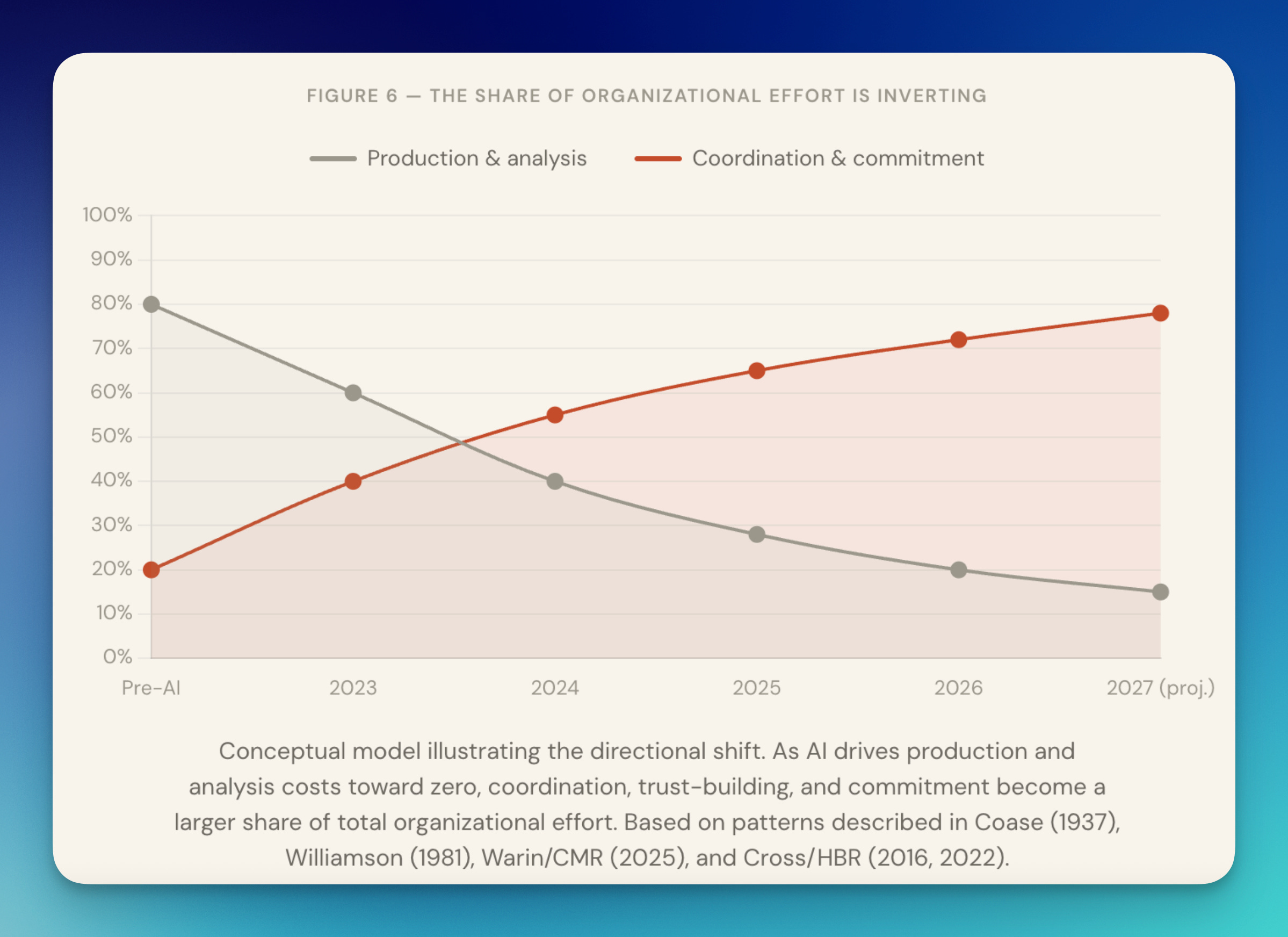
The tasks AI can cheapen are mostly the tasks of production and analysis. The tasks AI cannot (yet) cheapen are the tasks of trust-building, legitimacy-granting, and commitment-making. Those remain expensive because they are fundamentally social and political. They require humans who have skin in the game, reputations at stake, and relationships to maintain.
So the firm doesn’t disappear. It reconstitutes around the hard kernel of coordination that markets cannot efficiently provide: coherent commitment under uncertainty.
CODA
cheap intelligence doesn’t eliminate the need for companies. It clarifies why companies exist. Not to manufacture output. To manufacture coherent action which means coherent commitments under uncertainty, at scale, over time.
In my view, this all converges around a simple conclusion: the organizations that will thrive with AI won’t be the ones generating the most. They’ll be the ones that have built the tightest feedback loops between generation and commitment. They’ll replace sprawling alignment rituals with crisp protocols. They’ll make intent legible and provenance transparent. They’ll accept that the cheap layers of the old collaboration stack (artifacts, opinions, even analyses) are no longer differentiators.
What will differentiate is the ability to decide and commit at the speed the technology enables.
If you keep treating collaboration like “communication,” you’ll drown in output and starve for agreement.
If you treat collaboration as the design of commitment-making systems, you get something rare in 2026: A company that can move quickly and know what it’s doing.