

I used to believe the better product eventually wins.
Every product minded builder starts here. You have to, or you don't survive the long stretch of work that isn't immediately rewarded.
I don’t believe it anymore. I have shipped good product and have watched few care. I’ve shipped other products that have arrived at the right moment and took off.
I used to primarily ask whether something was good on its technical/functional merits based on its job to be done. Now I ask myself increasingly why it matters right now.
Of course, quality still matters and bad products will fail. But there is far too much being made in 2026 for anyone to judge it all. Figuring out whether something is good takes time. Figuring out whether something is “moving” because the zeitgeist can’t stop talking about it takes seconds. While momentum isn’t proof its good, it is a shortcut that gives you a reason to bother to look.
This isn’t new…
In 1989, a cryptographer named David Chaum built DigiCash: private digital money, arguably better engineered than what followed. It went bankrupt in 1998. Eleven years later, Bitcoin launched with the same core idea (money secured by cryptography) and rewired global finance.
The core idea was not new but there were two differences:
Timing: DigiCash arrived in a world that still trusted banks. Bitcoin launched into the wreckage of the financial crisis: that day’s bank-bailout headline is written into its genesis block.
Distribution: DigiCash was patented and centralized: nobody gained by spreading it. Bitcoin paid strangers to carry it and bitcoin mining made spreading the network profitable.
Now with our compressed tech cycle a new frontier model lands every few months and money rushes towards what is already moving.
Your best work has probably already lost to worse work with better timing. And you, like me, have probably done the filtering yourself: ignoring something excellent because it had no momentum and giving your attention to something “weaker” because everyone was already discussing it.
I’ve been thinking of calling this zeitgeist-market fit.
Product-market fit asks whether people want what you made.
Zeitgeist-market fit asks whether a larger force is already moving toward it: and whether what you built is in a form that force will be able to carry.
Two tests:
Can you describe the wave without naming your product? Bitcoin’s wave was not “digital cash is convenient.” Millions of people had just watched banks fail, get bailed out, and answer to no one. They stopped fully trusting institutions with their money. The zeitgeist is the appetite underneath the moment that will propel your product forward.
Does a stranger benefit from spreading what you made? Bitcoin’s network rewards its miners while DigiCash paid nobody. If sharing your product costs effort and returns nothing (no status, no saved time, no money) nobody will do it. That is a distribution problem, and a better product will not fix it.
Chaum’s company failed while his idea survived and so if most of your effort needs to go to explaining why the moment matters, the moment has not arrived.
AI has unleashed a swell of launches with more waves, more pressure to attach yourself to whatever is moving fastest. The answer is not to pretend timing is beneath you, and it is not to chase every wave until your work is a copy of whatever is already popular.
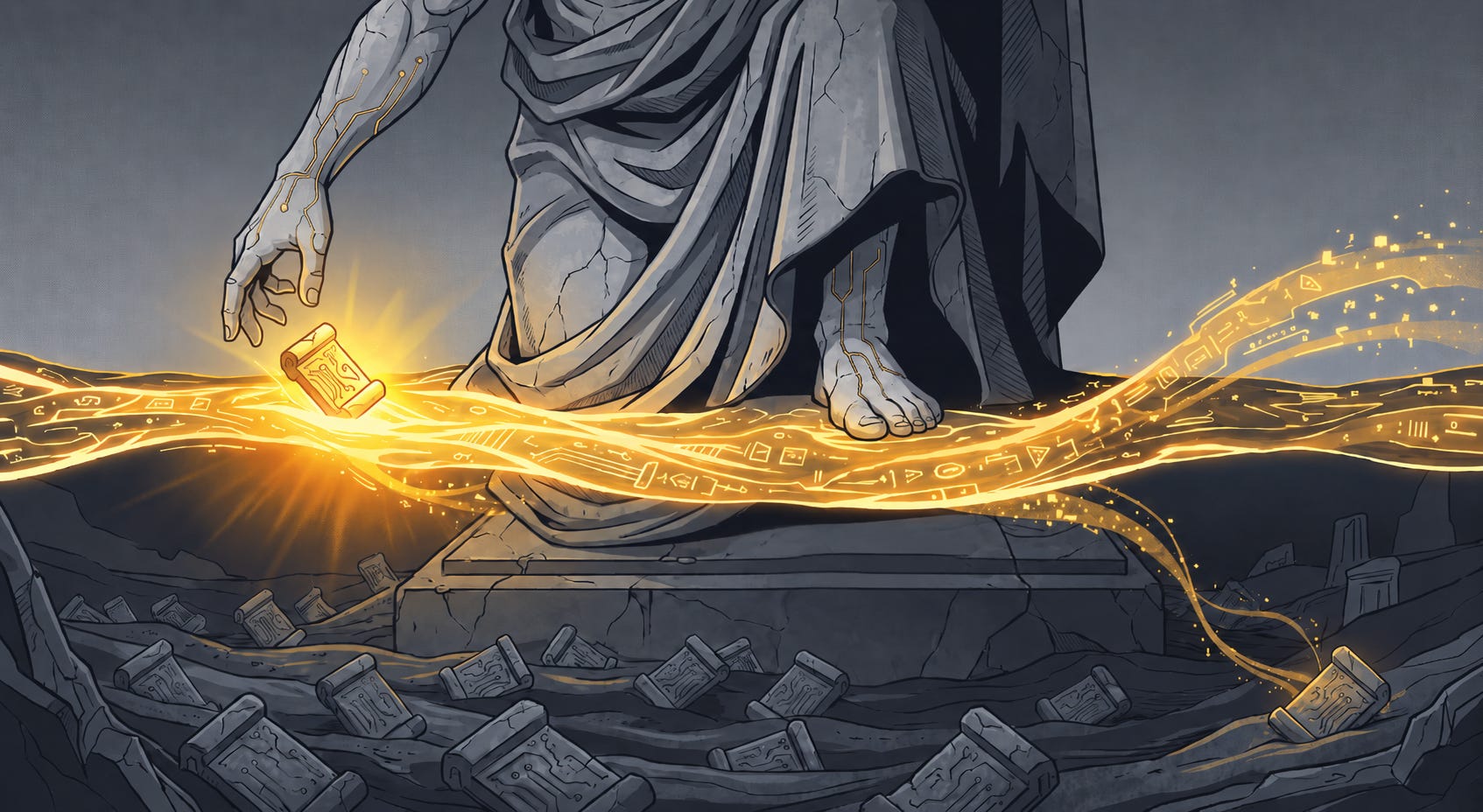
Marcus Aurelius described time as a river carrying events in a powerful current. The Stoic response was never to stop the river. It was to stay responsible for what you place into it.
The zeitgeist decides when. Momentum decides how far. Neither decides what you make.
That part is still yours.