

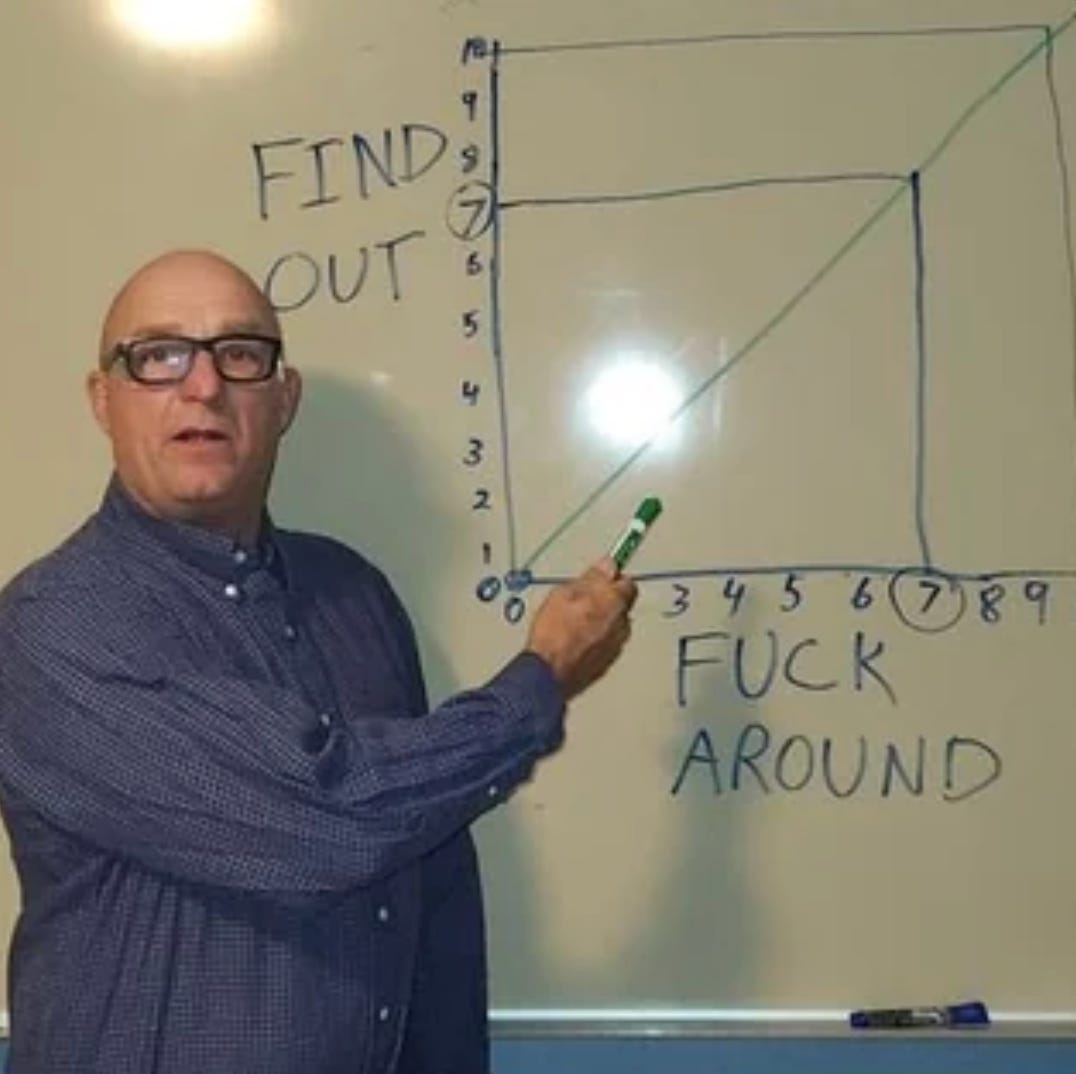
FAFO is a cultural expression that has become a warning. Its a smug little phrase people deploy after someone’s hubris meets an unfortunate reality. Oh, you thought you could do that thing? You fucked around. You found out.
But what really bothers me is how we use this now. This phrase describes something that’s actually, most of the time really good. Fucking around and trying things without permission, without credentials, without certainty is how you learn anything that matters. And finding out? It’s feedback. That’s just reality telling you something you didn’t know before.
The common negative version of FAFO assumes the finding out will be bad. That you’ll be punished for your audacity. But that’s not how it usually works. Most of the time, when you fuck around, what you find out is: oh, this isn’t as hard as I thought. Oh, I’m actually kind of good at this. Oh, this is interesting in ways I didn’t expect.
My view is that tragedy is not contained within the people who fuck around and find out something painful. It’s the people who never fuck around at all.
Over the years I’ve watched a specific pattern play out with smart, successful professionals (especially in tech). They get good at something. They build an identity around being good at that thing. And then, almost without noticing, they stop trying things they might be bad at.
Learn to ask of all actions, “Why are they doing that?” Starting with your own. — X. 37
The backend engineer who “isn’t a frontend person.” The designer who “isn’t technical.” The PM who “can’t code.” These aren’t descriptions of reality. They’re descriptions of what someone tried once, found difficult, and then built a wall around.
The problem is the regret math is backwards.
We overweight the downside of trying something new because it might require a few hours spent fumbling, the ego hit of being a beginner, the possibility that we’ll produce something embarrassing. These feel like real costs because they’re immediate and visible.
We underweight the upside: the new capability that compounds over days, months and years, the unexpected obsession that reshapes your career, the connection between domains that only you can see because only you’ve been in both. These don’t feel real because they’re probabilistic and distant.
So we protect our identity as competent people by staying inside the walls we’ve built. We tell ourselves we’re being strategic. Focused. Playing to our strengths. But really we’re just scared to be bad at something in front of ourselves.
The asymmetry is this: the downside of fucking around is capped. A few hours normally. Some confusion. Maybe you feel dumb for a week. The upside is uncapped. You might find a new career. A new way of thinking. A capability that makes everything else you do more valuable.
And yet we act like the reverse is true. We act like trying something new is a cliff we might fall off, when really it’s a pool we’ve been sitting next to for years, dangling our feet in, convinced the water is colder than it is.
In 2025 the biggest thing that made me want to FAFO more and more is that we all know the time between “I wonder if I could build that" and "I have a working version of that" has collapsed.
This isn’t about AI doing the work for you. It’s about AI compressing the feedback loop. The fucking around happens MUCH faster. The finding out happens even faster still. Which means the cost of each experiment trends toward zero.
You used to need months of prerequisites before you could even start. Learn the language. Learn the framework. Learn the tooling. Learn the conventions. By the time you could try the thing you were curious about, you’d often forgotten why you were curious in the first place.
Now you can describe what you want and have a conversation about it. The AI doesn’t replace the learning: no you still have to understand what you’re building. But it changes the sequence. You can start with the interesting part. You can fuck around on day one.
This is especially true for knowledge workers who’ve spent years adjacent to technology without building it themselves. You’ve seen what software can do. You’ve spec’d it, managed it, used it, complained about it. You have taste and judgment and domain knowledge. What you didn’t have was a fast path from “I have an idea” to “I have a thing.”
Now you do.
I’m not arguing for recklessness. Some domains have real consequences for incompetence and you and I should respect that.
But most of the walls we’ve built aren’t about real consequences. They’re about identity. About the story we tell ourselves regarding who we are and what we’re capable of. And those walls have never been easier to climb over.
Its about to be 2026. The water isn’t cold. The jump isn’t far. The only thing you’ll find out is what you’re capable of when you stop waiting for permission to try.
So fuck around. Please. Find out something good.