


If you sell an AI product right now, amongst your competitors is the unused half of your customer’s existing AI subscription.
Say you sell a $200/month tool that generates reports from disparate CRM, Social Feeds, etc. Every time your customer clicks that report button, you, the vendor, pay a lab per token through an API. Your margins depend on keeping that meter down.
Meanwhile, your customer is already also likely paying $200 to $600 a month for flat-rate Claude, ChatGPT or Gemini usage plans. If they haven’t hit their weekly usage cap yet, asking their own agent to build that report costs them $0 extra (excluding effort and time).
You’re asking them to pay a second bill for capacity they already bought and haven’t finished using.

As general coding/desktop agents improve, this comparison spreads from reports to dashboards, testing, and all sorts of recurring business workflows.
This is why it is tempting to wire products onto stacks of consumer subscriptions just to get on the same footing as their users.
But before you get locked into the assumption that frontier labs are lighting money on fire with these flat-rate plans, think about it from their side. Folks see a heavy developer burn what would be $5,000 of API tokens on a $200 subscription and wrong assume that the math doesn’t math.
However, most API pricing is a retail rack rate and not what inference actually costs a lab running its own hardware. Simply, the subscriptions are a portfolio business similar to gym memberships.
The developer hammering their agent at 2 a.m. gets subsidized by dozens of lighter users who barely scratch their weekly allowance. In exchange, the lab locks in predictable monthly revenue and becomes a default habit.

This is also why labs heavy scrutinize which harnesses they allow subscription usage to flow through. OpenAI is now allowing subscribers to spend their usage allowance inside select partner apps, with caps. Anthropic lets end users log into an unmodified Claude Code binary inside another product, while banning third-party apps from grabbing credentials to proxy their own backend traffic. An application business reselling API tokens has all the per-use cost and none of the wholesale cushion.
Better understanding this mismatch, it’s easy and seemingly logical to conclude that building AI software is a losing game and that you somehow have to beat $5,000 a month of frontier tokens for $200. But this line of thinking mixes up a bill with a result.
To look at it in such a way that we understand what need it fulfills, and in what kind of world. — III. 11
A frontier model will happily burn $5,000 going down dead ends, breaking working code, and apologizing. A focused app might deliver the exact outcome a customer wants using $5 of tokens and alongside its own deterministic code. Raw token spend isn’t the true benchmark to compete against.
Cost per finished verified task is.
Returning to the above example: even when a customer’s extra token spend is $0, doing it themselves isn’t free. They still has to know what to ask for, gather the right context, hook up the systems, spot subtle mistakes, and decide when the job is actually done.
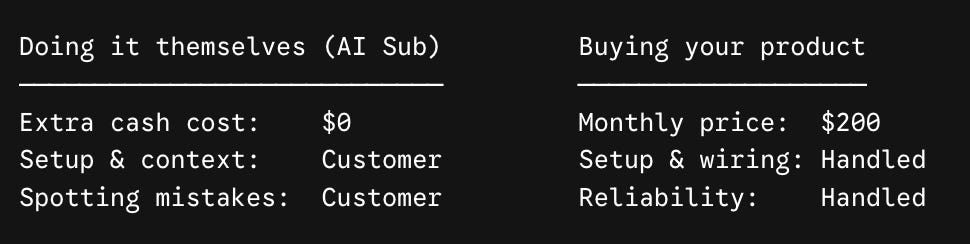
This is what subscription AI is creating true competition around.
It isn’t a contest over who gets the cheapest tokens but it is a race against the shrinking amount of human effort between having access to a smart model and getting real work and outcomes.
Flat-rate subscriptions speed that up by making DIY “feel free”. Better agents make it harder to ignore by eating away at the prompting and babysitting that used to protect software products. “We handle the workflow” only earns a $200 check when your app is clearly faster, easier, or more reliable than opening a terminal and letting their own agent take a swing at it.
Once you frame it this way, a few popular hot takes about AI businesses need a tweak:
Better models don’t automatically wreck your margins. But they do wreck thin wrappers. If your product truly owns a painfully real workflow, smarter models can actually make it cheaper to run as you need fewer retries, less glue code, and fewer steps to get a clean answer.
Software is still an asset, even if inference is COGS. A lot of people say software isn’t an asset anymore because you’re just burning tokens like fuel in a factory. That blurs building with running. Tokens spent building a reusable tool that serves ten thousand customers can still create durable value. Tokens burned redoing the same reasoning on every single request are a delivery cost.
Build evals before chasing custom models. Training a custom model that’s 100x cheaper than frontier sounds great until you have to maintain it. What almost every team actually needs are evals, repeatable tests that prove whether the job was done right. Once you can measure “good,” you can replace expensive frontier calls with caching, ordinary code and smaller off-the-shelf models.
Aim bigger on reliability, not token burn. A task isn’t a good business just because it’s too heavy for a consumer subscription. A boring job done reliably every day with zero babysitting beats a flashy, compute-hungry agent with terrible unit economics.
The lesson is that better models can make your product cheaper to deliver AND easier to replace at the same time. You benefit when they reduce the work required to produce your product. You lose ground when they reduce the work your customer needs you to do.
You aren’t going to out-subsidize the labs on tokens, so stop trying. The answer is to own the outcome, take babysitting off your user’s hands, and grind your delivery cost down behind the scenes.
A flat-rate plan with headroom is an all-you-can-eat buffet the customer already paid for, so every vendor with a report button is now a food truck parked outside it. Guilt does half the selling for the buffet, since nobody wants to waste a plate they paid for. Lovely framing of a competitor that never shows up on a pricing page.