

Somewhere in your company right at this exact moment, a great idea is dying on schedule. Not because anyone explicitly rejected it but rather because “the process” hasn’t finished saying not yet.
A lot of modern work doesn’t produce things, it produces evidence. Evidence that the right people were consulted. Evidence that risk was acknowledged. Evidence that there are throats to choke.
Intent to do something enters an organization and comes out the other side as action… eventually. In between, it gets translated through the permission pipeline
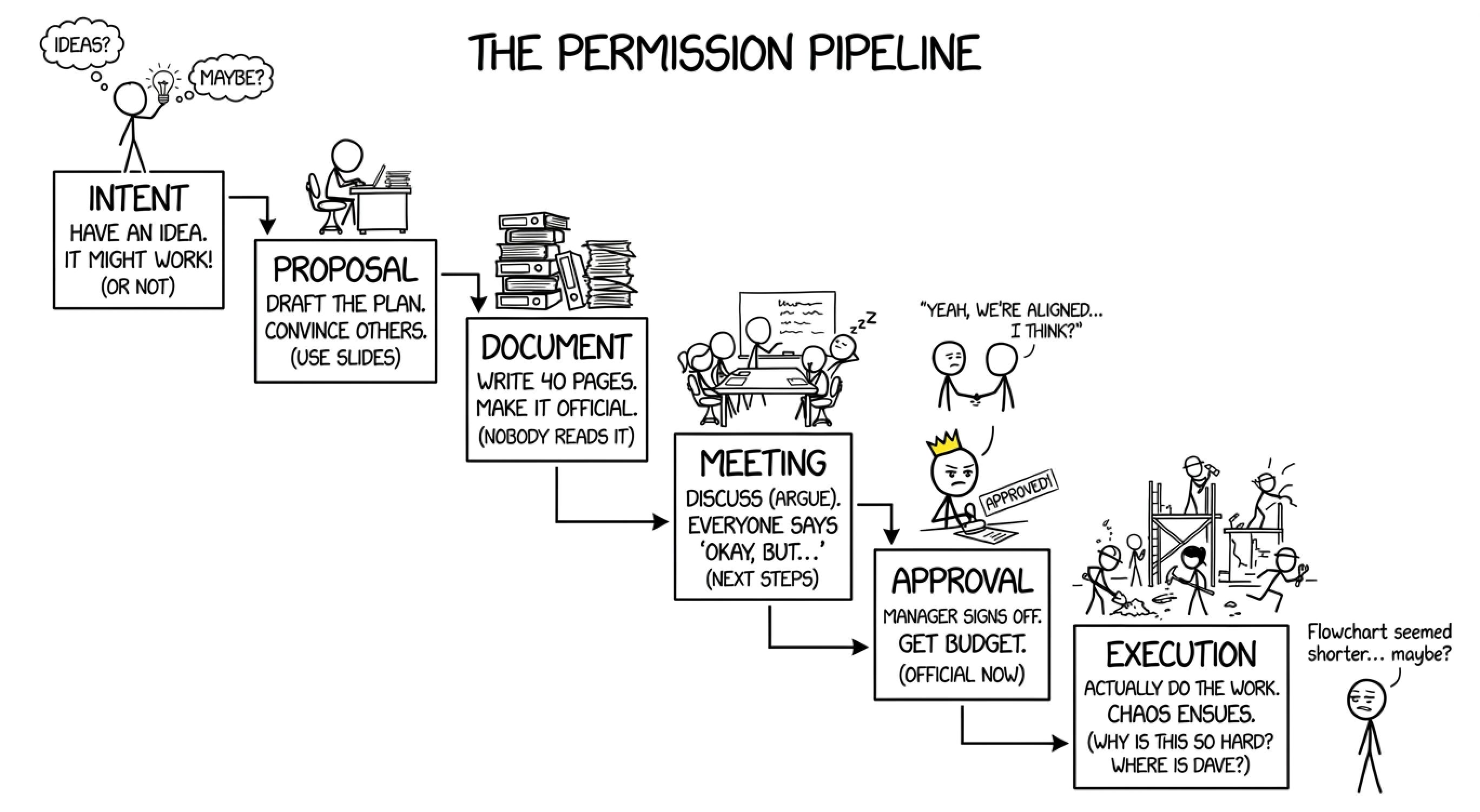
The translation layer is massive. It employs entire departments. Most of it exists not because coordination is genuinely needed but rather because delay is how organizations metabolize fear without admitting they’re afraid.
Delay gives people time to object.
Delay gives politics time to work.
Delay gives responsibility time to diffuse until no single person holds the bag.
You know the feeling. A competitor stumbles publicly and your marketing lead sees a three-week window to run a campaign against it. Sharp angle, right audience, real upside. They write the brief in an afternoon. Then the pilgrimage starts:
Route it through brand for tone review,
Legal for claims approval,
Demand gen for budget sign-off,
The VP for “visibility,”
Finance for the PO and procurement for the vendor contract.
Four weeks later the campaign is approved. But window closed nine days ago. Nobody killed it. Nobody even said no. The process said not yet until not yet became too late.
You’ve watched this happen. You wanted to scream. You didn’t. Because you knew: the pipeline isn’t protecting the company. It’s protecting individuals from the consequence of being the one who said yes.
Now drop in agents.
Give one that campaign brief and it does the annoying middle: drafts the copy in brand voice, pulls the competitive data, mocks up the landing page, routes the legal review, generates the media plan with three budget scenarios, files the PO. The translation layer that took four weeks compresses into days.
Everyone who used to be “in the loop” by default is now in the loop only if a gate demands it. The time buffer is gone. The political breathing room is gone. The comfortable ambiguity about who decided, yea that too, gone.
Most people may stop here. Compression eliminates waste. Everyone wins.
They’re wrong though. Compression doesn’t eliminate the fear. It makes the fear visible.
Bureaucracy isn’t waste, it’s ceremony.
The meeting is a ritual that says: we saw the risk, we shared the burden, we did the responsible thing. Compress the coordination layer and the ceremony disappears. The fear it was managing doesn’t. It just stops having a place to go.
So it goes somewhere predictable: more gates, more policy, more “human review,” more signatures. Not because people hate speed. Because people hate holding the bag when speed produces a mistake.
This is why every enterprise AI deployment hits the same wall. The technology compresses the pipeline. The organization re-inflates it. You automated the paperwork but not the anxiety.
You’ve seen this too. A team adopts a tool that should cut weeks off the cycle and within a quarter, new process fills every hour the tool freed up. Not because anyone decided to. Fear is a gas that expands to fill the container.
When the pipeline collapses, authority concentrates in two places:
The people who still say yes or no, and
The people who decide what requires asking in the first place.
The second group is the sleeper power center.
The future will be shaped by defaults. What runs automatically. What requires a tap. What requires a signature. What triggers a pause.
Most organizations may treat these as “process.” That’s a mistake. Defaults are policy. Gates are power. Whoever configures the gates is making the real decisions about how fast you’re allowed to move.
When the busywork of coordination disappears, the real coordination ( the kind nobody had a meeting template for) doesn’t get cheaper. It becomes much more expesnive AND unavoidable.
Judgment under uncertainty. Taste. Responsibility. Trust. Narrative.
These aren’t soft skills. They’re what’s left when the permission pipeline stops being a full-time job for half the company.
The impediment to action advances action. What stands in the way becomes the way. — V. 20
The impediment was never the campaign. It was the fear dressed up as process and the process dressed up as work. You felt it every time you sat in that meeting. You feel it now.
The permission pipeline will collapse. The question underneath it is who bears the risk when we move fast was always there. The process just let everyone pretend it wasn’t.
That pretending is over.