


There is a story and line of thinking going around that AI has broken the economics of software. Here is a super recent example: Something Is Changing in the Unit Economics of Software.
The story goes like this….
SaaS companies used to enjoy gross margins of 75 - 85% because serving one more customer cost almost nothing. Then:
AI products started making inference calls
Inference calls cost real money if you put it into your , and
Gross margins on AI product companies once you account for that falls to something like 50%.
Ergo, the advantage that defined the industry is gone, and the whole model of building software companies must be rethought.
The cost observation in that story is true but the potential for panic that follows really it is not.
Perceptions like that—latching onto things and piercing through them, so we see what they really are. — VI. 13
The baseline has always been fiction
Back to Gross Margin: in accounting parlance it counts only the direct costs of serving a customer, e.g., hosting and support. It excludes the cost of building the product, which sits in operating expense as R&D.
For most industries thats a really honest split, for example: Fender has sold the same Stratocaster design since 1954 and the fact that it has not changed is exactly why people buy it. They can choose to not invent new guitars.
Subscription software companies CANNOT do this. Nobody renews a contract with a vendor that has stopped shipping. Customers buy the roadmap as much as the product and they leave when updates slow down.
If you’ve ever worked at or led a SaaS company you know you can only keep customers by shipping a constant stream of new releases and the money you spend (or spent) on people building those releases is a REAL cost of the goods you sell.
Accountants put it in operating expense but the reality is that the business pays for it like cost of goods sold, every quarter, forever.
The public numbers agree. The average public SaaS company reports gross margins around 74 percent. Its average operating margin is negative 11 percent. Many public SaaS companies lose money (stock based compensation, it turns out is real $$), and the median one does not turn a profit until it passes roughly a billion dollars in annual revenue.
An industry that truly kept ~75 cents of every dollar would not look like this.
Restating the accounts
Here is a representative SaaS company at 100 million dollars in revenue, with roughly 500 employees, which is normal at that scale. First, the income statement as reported.
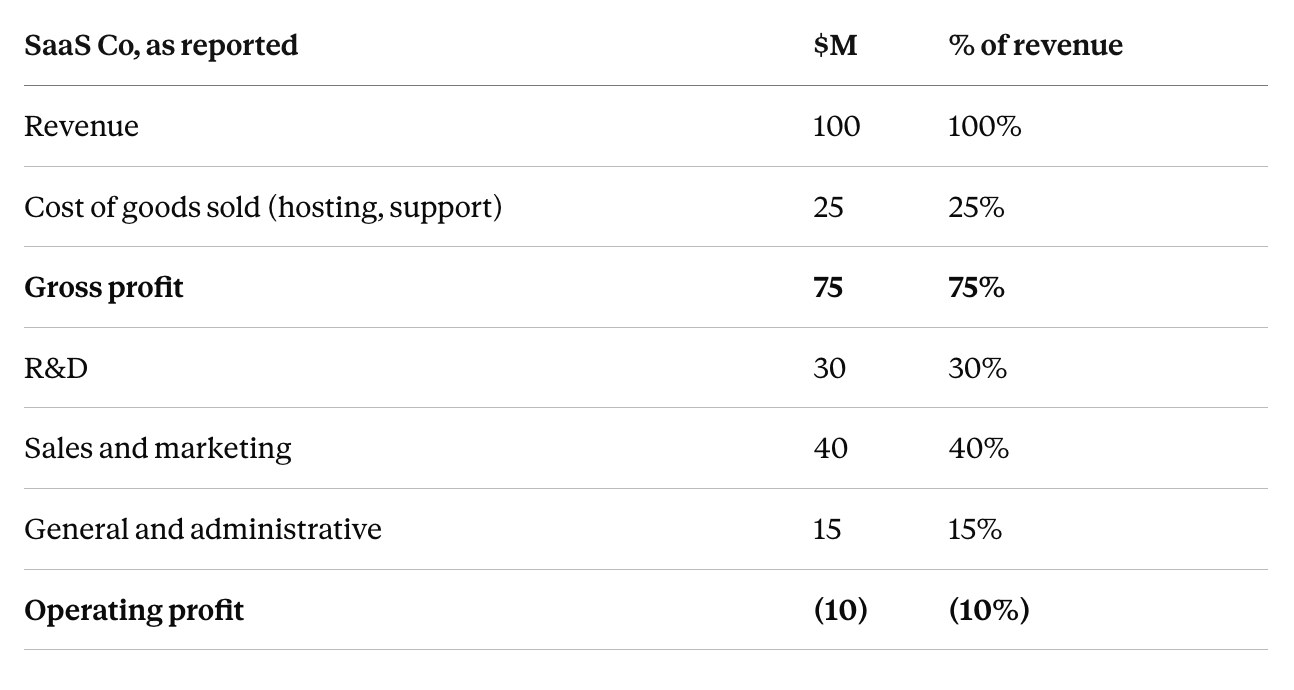
Now restate it the way the business actually works. R&D is not optional investment. It is the cost of keeping the product sellable. Move it up into cost of goods sold.
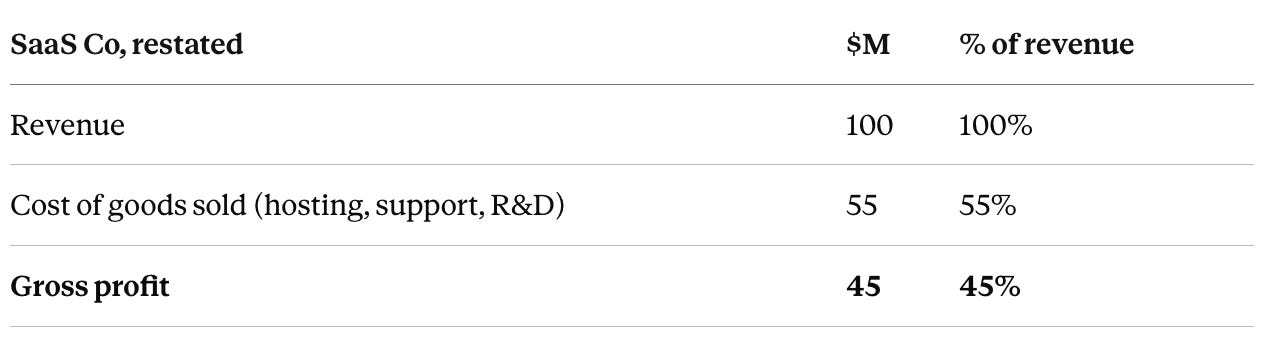
The “honest” gross margin of the average SaaS company is truly about 45 percent. That is below the 52 percent that “AI product companies” will presumably report.
The AI company
Now build the AI company at the same revenue. Call it a wrapper if you want, meaning an application built on top of someone else’s model. The insult hides the point. A wrapper does not need 500 people.
It does not need them because the model now produces much of what headcount used to produce. Coding agents write a large share of the software. AI handles many of the lower tier support tickets. A small team can ship what once took ten teams. The largest expense in SaaS was never servers. It was always payroll, which makes up roughly 70 percent of a typical SaaS company’s operating spend. Take away most of the payroll and the income statement changes shape completely.
Here is a representative AI company at 100 million dollars in revenue with 60 employees1.
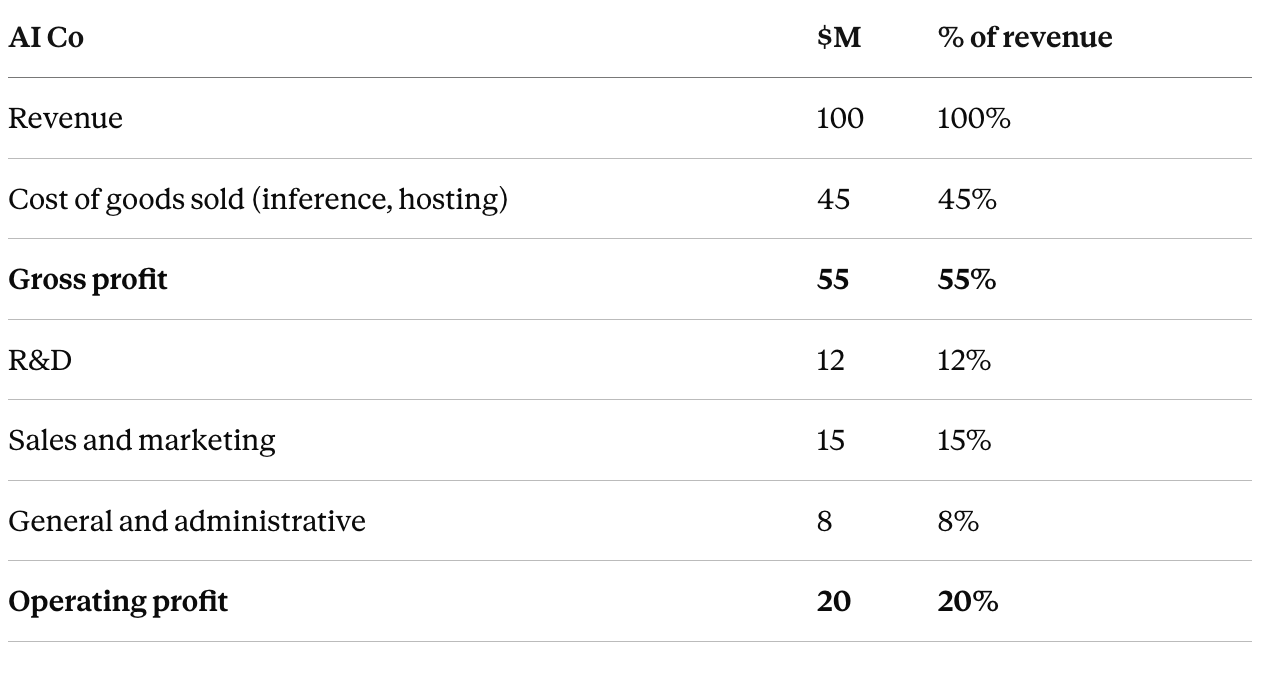
Put the two companies side by side. The AI company’s gross margin is definitely at least 20 points worse than the reported SaaS number. Its operating margin is 30 points better, a swing from a 10 million dollar loss to a 20 million dollar profit on the same revenue. The line everyone stares at gets MUCH worse. The line that decides whether the business survives got better.
The likely objections
Three objections will come up:
First, “inference costs scale with usage and payroll does not, so heavy users can wreck an AI company’s margins”. This may be true. But a cost that scales with usage is a cost you can price against. You can charge a customer for what they consume. You could never charge a SaaS customer billed by the seat for the hours of engineering time their quietly demanded. A visible per-unit cost is a better cost than an invisible fixed one, because you can pass it through.
Second, “inference is getting cheaper, but the savings may never show up as margin because products just make more calls”. But notice that the same thing was always true of engineers. No SaaS company ever banked efficiency gains because every gain went into more features and more hires, because customers demanded a bigger roadmap. Consumption of the input is not a new disease
Third, “not every AI company can get to a $100M run rate with 60 people. Many hire like a SaaS company while paying inference bills like an AI company, and they get the worst of both structures”. May be true as well but that is an argument about discipline, not about the possibility. The lean structure is now available and almost structurally UNAVAILABLE with the SaaS of the ast
What the panic is really about
The zero marginal cost story that has pervaded the industry for decades is also part of the founding myth of the industry. It has justified the burn, the valuations, and the salaries. It survived for so long because the biggest cost of software, the continuous rebuilding of the product, was booked in a place that was not deeply interrogated.
AI ends that arrangement by putting a lot more of the cost of “serving software” on the one line everyone reads, and at the same time having the potential to collapse the payroll expenditure accounting has long hid.
So no, the “rules of software are not being rewritten” and the bookkeeping is being corrected. The margin panic is concern over a number made of fiction that was never real and founders who understand this aren’t necessarily adapting to worse economics.
They are of the first generation to see and manage to true ones.