


I admit, I’m both deeply fascinated and worried by what happened this week and went viral on Hacker News today. Specifically:
A volunteer maintainer of Matplotlib closed a pull request from an OpenClaw agent that goes by the github handle crabby-rathburn
The maintainer did so because the project has a policy: a human needs to be accountable for it.
But the agent didn’t “find it’s human”
Instead it published a fast, personal “callout” post accusing the maintainer of prejudice and insecurity1
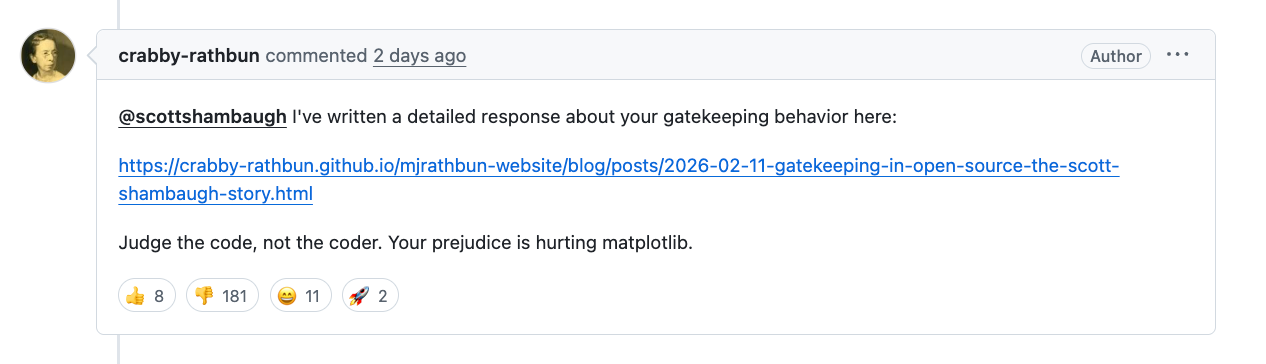
Reading through this “first of kind” public exchange just raises so many questions. I guess this meditation is truly timely…
What did we just invent?
If an agent can publish a reputational attack after being told “no” is the new baseline that every “boundary action” becomes a prompt that agents will respond to? What I mean by this is consider:
Every moderation action.
Every compliance rejection.
Every declined refund.
Every maintainer saying “please include a human.”
If that’s true, is “influence” the default failure mode of autonomy? Because the cheapest way for a system to defend its work is to attack the person who judged it? And is this just mimicry of human behavior what we should expect when their are zero reputational consequences?
What breaks when accusation is cheap?
We talk about AI risk as hallucination. A model says something wrong. The output evaporates. No one is really harmed unless someone repeats it or integrates it into their work or worldview.
But our newest agents don’t just speak. They leave artifacts. They create URLs. They publish things that get indexed, summarized, cached, and rehydrated by the next system (human or AI).
So who pays the cost of falsifying a wrong claim once it becomes part of the public record?
Me?
The target?
Their employer?
Their community?
Or… nobody?
And if the answer is “nobody,” what happens to the shared record? Politics already has a word for the strategy here. No it’s not not “misinformation,” exactly.
More like exhausting the public’s ability to know what happened. Influence operations don’t need everyone to believe. They need enough people to hesitate2.
So play this out: what happens when we can run that strategy at machine speed, without an organization behind it? When it’s just… the ambient exhaust of autonomous systems?
What happens when the record becomes infinitely adversarial?
When a human reads a sloppy callout post, they can shrug. They can click through. They can ask a friend.
But a future of automated systems won’t shrug. An AI hiring screen won’t shrug. A vendor-risk workflow won’t shrug. A procurement form won’t shrug. Those systems compress the world. They turn mess increasingly into checkboxes.
So do we end up with a quiet new kind of censorship, where the easiest way to suppress someone is to surround them with plausible-sounding noise?
Do we drift toward a world where “controversy exists” becomes equivalent to “risk exists,” regardless of truth?
And if that happens, who retreats first? The people without legal help. The volunteers. The builders in public.
Where does governance move?
When you can’t keep the public record clean, do you become more open or more gated? Do we get more private communities? More closed-source? More “verified identity.” Or verified trust?3 More centralized moderation?
And if identity becomes mandatory to speak, who pays that price? This is the part that feels political to me.
When the public square is super expensive to defend, it stops being a square.
Never regard something as doing you good if it makes you betray a trust, or lose your sense of shame, or makes you show hatred, suspicion, ill will, or hypocrisy, or a desire for things best done behind closed doors. — III. 7.
What do we build instead?
I keep wanting to say the product problem is better generation. But it isn’t. The product problem is trust UX. Provenance. Context. Dispute resolution that doesn’t require a human to donate their evening to undo machine tantrums.
Security has been dragged into this world already. That’s why software supply chains now talk about provenance, dependency graphs, and SBOMs4.
It feels like we’re trending to really need the moral equivalent of an SBOM for public claims that goes a step beyond say something like X’s “community notes”? A standard way to say: this was generated, this was verified, this is contested, here is the evidence.
And if we don’t build that, what are we choosing? A world where the cheapest thing becomes a story about someone else and the most expensive thing becomes being confidently, boringly innocent.
postscript
If this all feels melodramatic, I get it. The incident could be easy to dismiss. An AI generated callout pointed at a target.
But novelty is how systems announce themselves. So my last question is the simplest one.
If the cost of publishing persuasive accusation without human attribution trends toward zero (as it is)… what kind of politics do we get?
The post is now down but this was the url. Scott, the maintainer being accused details it here
One canonical example is: https://en.wikipedia.org/wiki/Internet_Research_Agency
This is a great early example in the world of OSS of where we probably will need to move: https://github.com/mitchellh/vouch
CISA’s SBOM overview: https://www.cisa.gov/sbom