

Our machines got good. Ask, and you shall receive: precisely what you asked for, ranked, referenced and summarized. But your LLM will not hand you the book one shelf over. It does not misread your question in a way that turns out to be better than your question. It will never seat you next to a stranger.
It gives you the exact thing. And very little else.
We treat everything around the exact thing as waste. The card-catalog detour. The wrong abstract. The talk you wandered into because the right one was full. Friction, we call it. Noise in our search process.
Reflect on your actual life. No one has ever retrieved a best friend. You did not query your way directly to the person you married, the city that became home, the work that became yours, the belief that has rearranged you. Each arrived sideways and likely while you were looking for something else.
Its one of the oldest laws of finding: you have to be looking for something to find something else. Serendipity was never noise in the search. For much of what mattered most, it was the search.
Song Stitchers
Before books, Homer lived in the mouths of wandering men called rhapsodes. Rhapsodes means song-stitchers: rhaptein, to sew; ōidē, song. They carried the verses from town to town and stitched them together live: to this room, accompanying this wine, this weather and these faces. No two Iliads were ever the same Iliad. The poem existed only in the performance and in whatever way got sewn in that particular night.
And every rhapsode opened the same way. Sing, Muse. It may seem like decoration but it was, in many ways, a declaration of dependency or an admission that the singer was not sufficient to the song. The best part would have to come from somewhere they could not control.
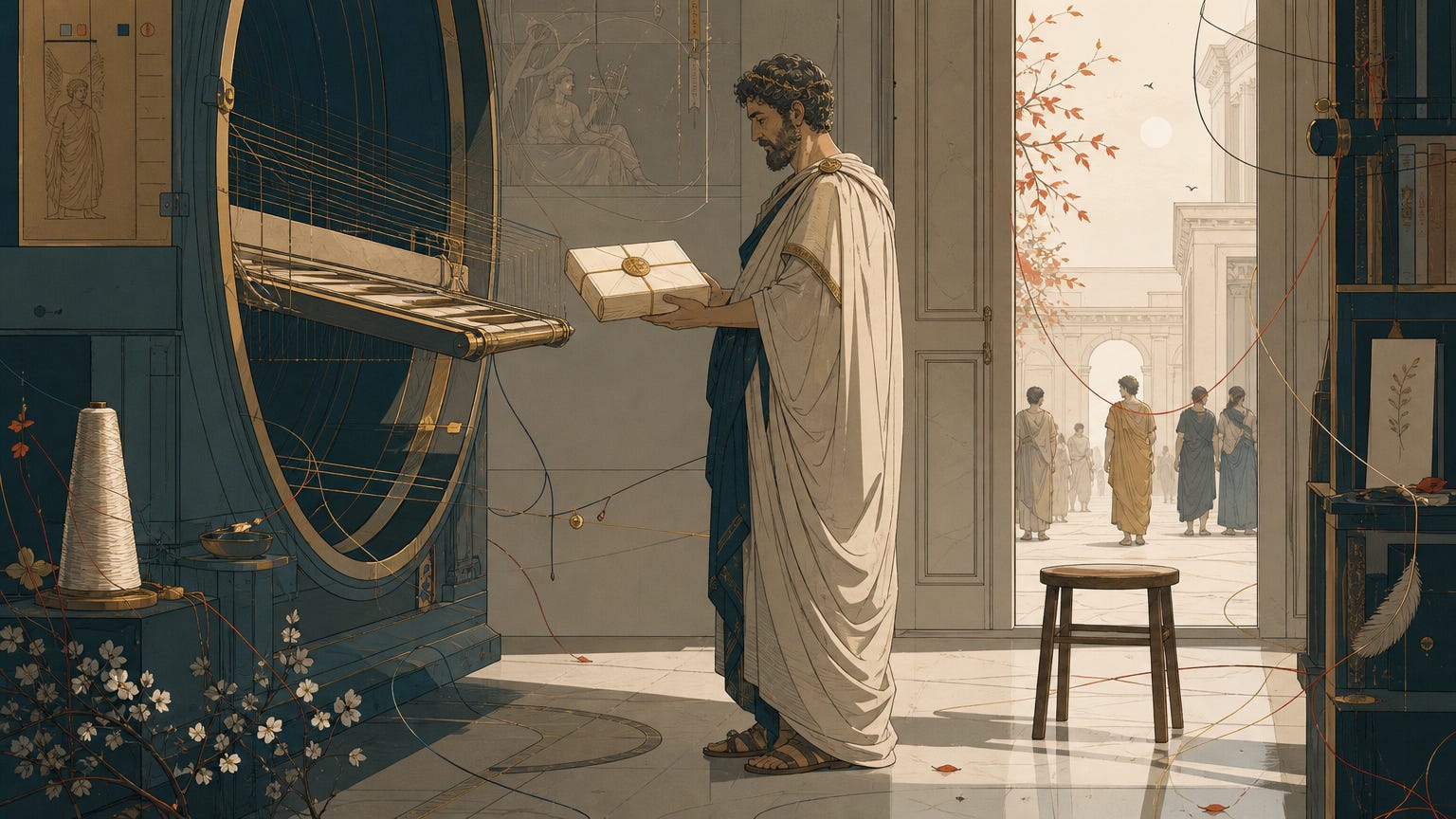
The ancients built whole systems around this humility. Fortuna received a wheel and a temple. The Muses received nine names and a mountain. The Stoics went further still. Marcus Aurelius imagined existence as a loom: whatever befalls you has been spun into the same thread as your being. The wrong turn is not interference in the weave. It’s the weft.
Something happens to you. Good. It was meant for you by nature, woven into the pattern from the beginning. — IV. 26
We’ve inherited all of this and replaced it with ranking algorithms. We took humanity’s oldest posture toward the unexpected, reverence, and traded it for relevance.
Slack in the line
I build retrieval tools. My company’s newest product exists so you never lose a thread, never forget where you left off, always resume from the exact context that matters. I am professionally, financially, against the lost thread.
So believe me when I say some threads should stay lost. The hands not holding them are the only hands free to catch what comes sideways.
Query and quest are the same old word: quaerere, to seek. Somewhere along the way, we kept the query while discarding the quest.
A query often begins with the confidence that you know what you want. A quest begins when that confidence fails. Our machines are quite perfect at one of these.
This is not an argument for abandoning our tools. It is an argument for leaving slack in the line. Take the exact answer, then notice the world it has removed. Read the adjacent page. Walk the last few blocks without directions. Enter the room that was not meant for you. Sit at the bar instead of carrying the drink upstairs. Do not optimize every empty space before something else has the chance to enter it.
We are building a world in which fewer things will be lost. This is mostly good. Lost knowledge is wasteful, lost context is expensive, and lost work must often be done again. But a life in which nothing is lost is not necessarily a life in which everything has been found. The same systems that recover what matters can make us less available to what has not yet announced its importance. That is the danger of a world that answers too well. It does not merely remove inconvenience. It removes exposure, narrowing the world to the terms of the question and quietly excluding whatever could not be stated in advance. The answer becomes more precise while the life around it becomes less permeable.
The rhapsodes understood this. Their posture toward the best part of the song was invitation. They began with what they knew, then left room for what they could not produce alone.
This may be the discipline the machines now require of us most. Restraint. Not a rejection of precision, but a refusal to let precision occupy the whole field. Ask for what you need. Retrieve what you lost. Resume the thread. Then leave some part of the day unresolved, some question unasked and some chair unclaimed.
You do not command the good part. You do not specify its format. You do not improve the prompt until the universe complies. You make yourself available to it.
Sing, Muse.
And keep the stool beside you empty.